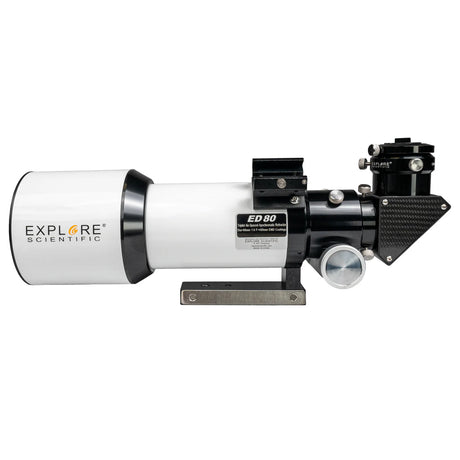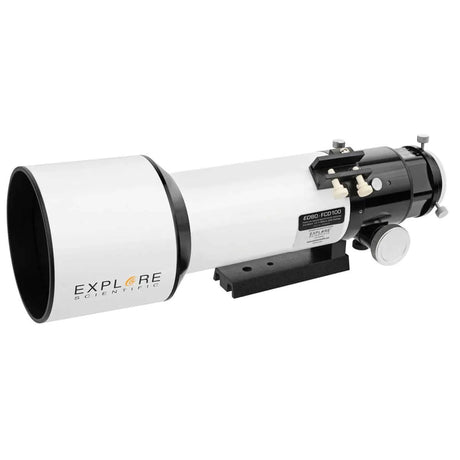



Explore Scientific ED80 80mm f/6 FCD100 Triplet Refractor Telescope
Explore Scientific ED80 80mm f/6 FCD100 Triplet Refractor Telescope is backordered and will ship as soon as it is back in stock.
Shipping & Returns
Shipping & Returns
We offer free US standard shipping on orders over $99 and 30-day returns on most items. Some limitations apply.
Shipping Policy
30-Day Return Policy

An 80 mm refractor earns its place in an imaging kit when the focuser holds a camera without slipping and the glass keeps color under control on bright stars. The Explore Scientific ED80-FCD100 Series is Explore Scientific's 80 mm f/6 air-spaced apochromatic triplet with HOYA FCD100 ED glass, comparable to Ohara's FPL-53, and a 2.5-inch hexagonal focuser rated for imaging setups up to 10 lb. In the video below, Explore Scientific collects about 11 hours of the Sadr region in Cygnus with this tube, its 0.8x focal reducer and an iEXOS-100 tracker.
Key Features
- Which ED80 this is. Explore Scientific makes two ED80 triplets with the same 480 mm focal length, f/6 ratio and 18.5-inch tube. This FCD100 Series (FCD100-0806-02) has HOYA FCD100 glass and the 2.5-inch hex focuser in a 7.5 lb tube. The ED80 Essential Series has HOYA FCD1 glass and a two-speed 2-inch rack-and-pinion focuser, and costs less.
- FCD100 glass. The FCD100 element sits protected between two other air-spaced elements to suppress chromatic aberration, and FCD100 glass has an Abbe number of 95.10. Explore Scientific's proprietary EMD multi-layer coatings increase light transmission.
- Hex focuser. The Hexafoc focuser has a high load capacity and a 10:1 micro drive: a coarse and a fine focus wheel, a clamping screw that fixes the drawtube for photography, and an adjusting screw that takes up gear backlash. For camera spacing, extension sleeves fit between the drawtube and the eyepiece holder.
- Two imaging configurations. Explore Scientific's 0.8x Focal Reducer fits FCD100-0806-02 and turns the 480 mm f/6 into 384 mm at f/4.8. The Field Flattener f/5 to f/7 keeps 480 mm and is for photography only. Each needs 55 mm (±2 mm) of spacing to the sensor and takes a T-ring, and Explore Scientific bundles this tube with both.
- Guide scope or main scope. It works as a standalone grab-and-go telescope and as a guide scope paired with a larger telescope.
Who It's For
- Imagers building a portable rig. The video above pairs it with the iEXOS-100-2 tracker, rated for about 9 lb of equipment; the tube takes 7.5 lb of that. For a heavier camera and guide scope, the EXOS2-GT PMC-Eight mount carries 28 lb of instrument for astrophotography.
- Visual observers. The included 99% reflective 2-inch diagonal takes 2-inch eyepieces, and its 1.25-inch adapter takes the rest.
- Owners of a larger telescope who want an 80 mm guide scope that can also image on its own.
- Choosing an ED80. If the camera is light and the budget matters more than the glass, the Essential Series is the same focal length for less. For more aperture with FCD100 glass, the ED102 FCD100 Series collects (102 ÷ 80)², about 1.6 times, the light, at 12 lb.
Accessories & Compatibility
- Mounting. A Vixen-style dovetail is built onto the tube, so no cradle rings are needed.
- Finder. Not included. The Hybrid Finder Scope Base accepts all legacy Explore Scientific finder brackets and mini dovetail-type finder brackets.
- Visual back focus. Two extension tubes come with the focuser for eyepieces that need more travel.
-
Objective Lens Diameter
-
Focal Length
-
Focal Ratio
-
Barrel Size
-
Weight
-
Optical Glass Type
-
Lens Coating
-
Lens Design
-
Limiting Magnitude
-
Resolution
-
Dimensions
-
Other Details
-
Warranty
-
Item Number
Payment & Security
Payment methods
Your payment information is processed securely encrypted during transmission. We do not store credit card details nor have access to your credit card information.
Compare Explore Scientific's ED80 refractors
| Facet | ||
|---|---|---|
| Price | ||
| Price |
Sale price
$559.99
Regular price
$699.99
Unit price
|
Sale price
$895.99
Regular price
$1,119.99
Unit price
|
| Optical Glass | ||
| Optical Glass | ||
| Lens Coating | ||
| Lens Coating | ||
| Resolution | ||
| Resolution | ||
| Limiting Magnitude | ||
| Limiting Magnitude | ||
| Weight | ||
| Weight | ||