




Focal extender or Barlow?
Both multiply magnification. A traditional Barlow's factor can change with the spacing to the eyepiece, while Explore Scientific's telecentric extenders give the same factor every time and hold the eyepiece's eye relief, so a long, comfortable eyepiece works like a short one without pressing your eye to the glass.
Choosing a factor
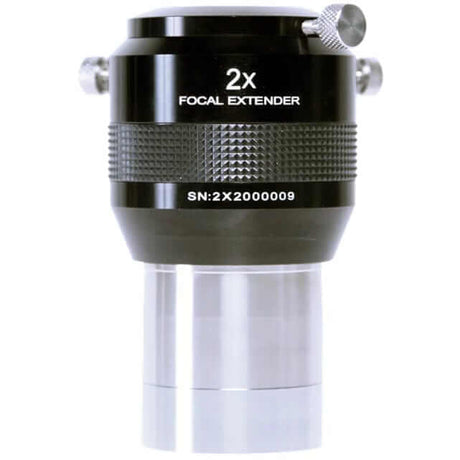
2x
The 2x doubles every eyepiece you own. Three eyepieces for low, medium and high power, plus a 2x, cover almost everything.
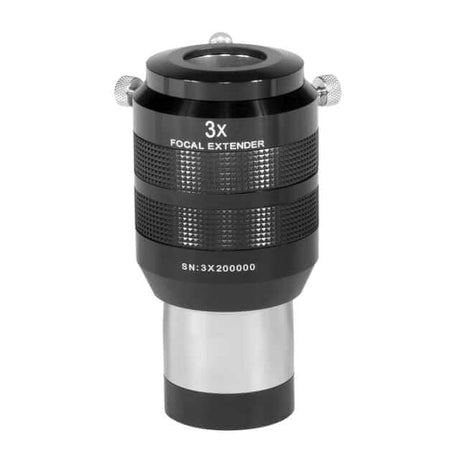
3x
The 3x turns a 15 mm eyepiece into a 5 mm equivalent, or a 2-inch 30 mm into a 10 mm, for planetary detail.
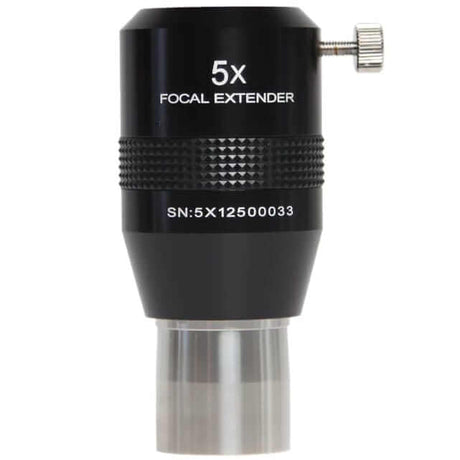
5x
The 5x turns a 20 mm eyepiece into a 4 mm equivalent, for extreme planetary magnification on telescopes where a 2x or 3x does not reach. It is a four-element design with a filter thread for color and nebula filters.
Barrel size
The 1.25-inch extenders take 1.25-inch eyepieces and weigh about 9 oz, and the 2-inch models take 2-inch and 1.25-inch eyepieces and weigh 20 to 22 oz. The 2-inch 2x carries EMD multi-coatings on every air-to-glass surface.
Frequently Asked Questions
Can a 3x give too much magnification?
It can. The useful limit is about 2x per millimeter of aperture, and the air rarely allows even that, so match the factor to your telescope's focal length and aperture.
Can I use one for imaging?
Yes. Explore Scientific describes the 5x for high-resolution lunar imaging with a camera.
Will it work with my eyepieces?
With any eyepiece of a barrel size it takes: 1.25-inch eyepieces in the 1.25-inch models, and 2-inch or 1.25-inch in the 2-inch models.
Which factor should I start with?
The 2x. It doubles every eyepiece you own, so three eyepieces give you six magnifications.
For the eyepieces to pair them with, browse our eyepieces.