



Why binoculars for astronomy
Binoculars are the quickest way into the night sky. Two eyes pick up faint, low-contrast detail better than one, a 7x50 or 10x50 shows 6 to 8 degrees of sky against about 1 degree in a telescope, and the view is upright and the right way round, so it matches your star chart. A handheld 10x50 already shows craters on the Moon, Jupiter's four large moons and the Andromeda Galaxy.
Giant binoculars: the BT line
Aperture, weight and mount
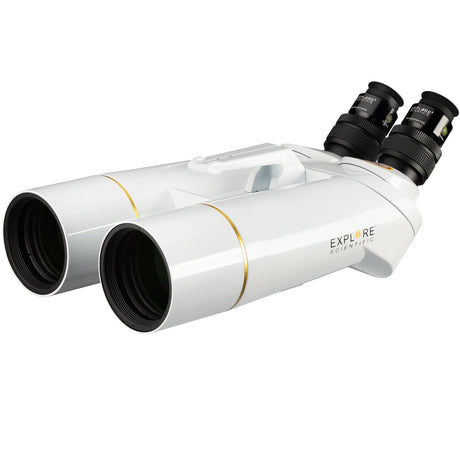
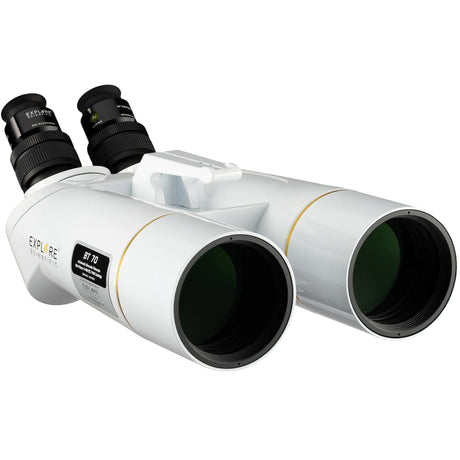
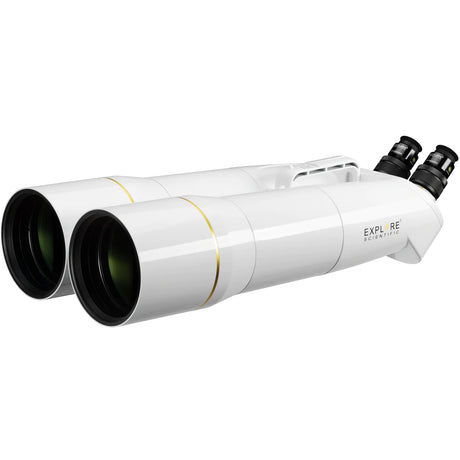
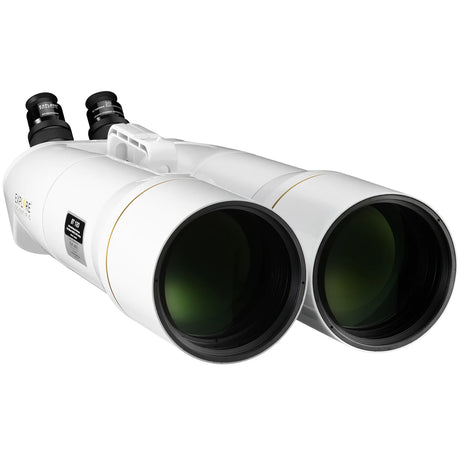
A BT binocular is a pair of short refractors built into one body. Aperture sets how faint you can go, and weight sets the mount: the BT-70 SF weighs 7.5 lb, the BT-120 SF 18.3 lb and the BT-150 ED 41.2 lb without eyepieces. Most camera tripods are not sturdy enough, so budget for a proper mount such as Explore Scientific's U-mount.
Eyepieces and glass
Magnification comes from the eyepieces, which you change in matched pairs: the supplied 20 mm eyepieces give 20x on the BT-70 SF, 33x on the BT-120 SF and 42x on the BT-150 ED. The two SF models use achromatic objectives, which leave a faint violet fringe on bright stars and the Moon's edge, while the BT-150 ED uses ED glass. The SF models view at 45 degrees, comfortable from the horizon to well up the sky.
Frequently Asked Questions
Are giant binoculars worth it compared with a telescope?
Yes, if most of your observing is wide targets: star clouds, large open clusters and bright nebulae, which two eyes and a wide field show at their best. A telescope still does a different job, with the high magnification the planets need.
What size binoculars should I start with?
A 10x50 is a good first pair: it shows the Moon's craters, Jupiter's moons and the Andromeda Galaxy, and you can hold it by hand. See our binoculars. Giant binoculars show far more, but they need a mount.
Can I use binoculars with glasses for stargazing?
Look for 15 mm or more of eye relief, which Sky & Telescope suggests for glasses wearers. The BT-70 SF and BT-120 SF come with Long Eye Relief eyepieces.
For the BT line in depth, read Best Giant Binoculars for Astronomy.