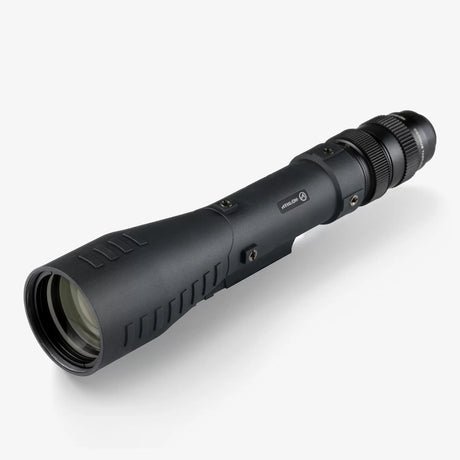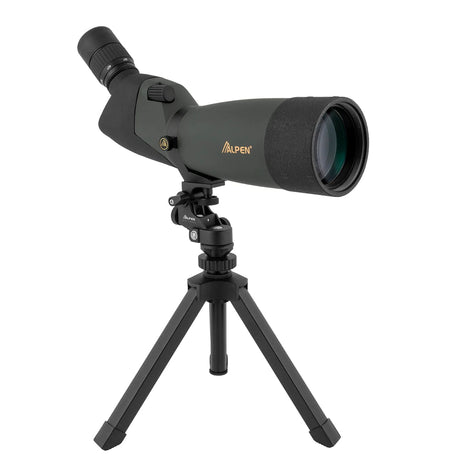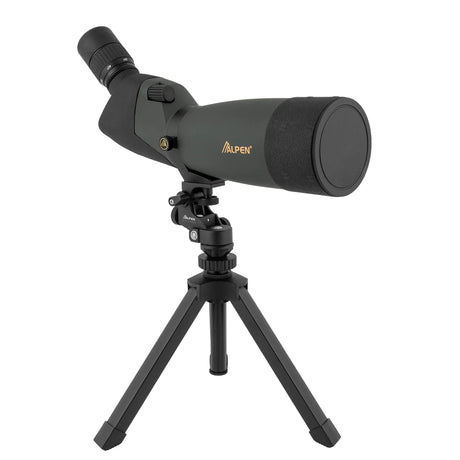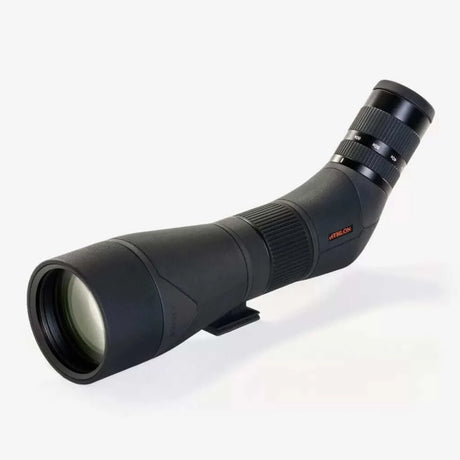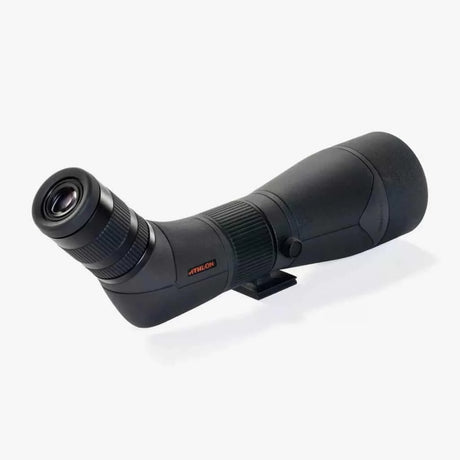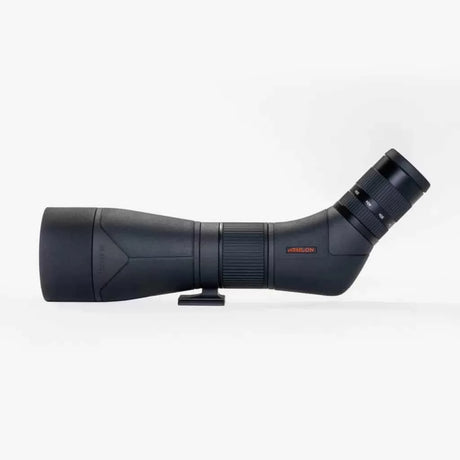

When binoculars can't pull in enough detail (a hawk perched 300 yards out, a bullet hole on a paper target, or a shorebird you need to identify by plumage), a spotting scope bridges the gap. With 20–60x magnification and objectives up to 100mm, a quality spotting scope mounted on a tripod delivers resolution that handheld optics simply can't match.
This guide covers the specs that matter, how to choose between angled and straight bodies, what to look for in glass and coatings, and how to match a spotting scope to your activity and budget.
Looking for a broader overview of sport optics? Start with our Sport Optics Buyer's Guide.
Understanding Spotting Scope Specifications
Spotting scope specs follow a similar format to binoculars: a number like 20-60x80 tells you the zoom range and objective lens size. Here's what each spec means and why it matters.
1. Magnification Range
Most spotting scopes use a variable-zoom eyepiece, typically 20-60x or 15-45x. The low end (20x) is for scanning wide areas and finding targets. The high end (60x) pulls in fine detail on distant subjects.
In practice, atmospheric conditions often limit usable magnification. Heat shimmer and air turbulence mean that above 40-45x, image quality degrades on warm days. Cold, calm mornings give the sharpest high-power views. Start at the low end, find your subject, then zoom in only as far as conditions allow.
2. Objective Lens Diameter
The front lens size determines how much light the scope gathers. Larger objectives mean brighter images, especially at dawn and dusk.
- 60-65mm: Compact and lightweight. Good for daytime use and hiking where every ounce counts. Limited in low light.
- 80-86mm: Excellent balance of brightness, detail, and portability, suited to birding, hunting, and range shooting.
- 100mm+: Maximum light gathering for serious dawn/dusk observation or digiscoping. Heavier, so plan on a sturdy tripod.
3. Eye Relief
The distance between the eyepiece and your eye where you see the full field of view. If you wear glasses, look for 15mm or more of eye relief. Most quality eyepieces have twist-up eyecups with click-stops to adjust for glasses or bare eyes.
4. Field of View
How wide an area you see at a given magnification, measured in feet at 1,000 yards. At low power (20x), expect around 100-115 ft at 1,000 yards. At 60x, this narrows to roughly 47-60 ft on the 20-60x scopes we carry. A wider FOV makes it easier to find birds and track moving subjects before zooming in.
5. Close Focus Distance
The minimum distance at which the scope can produce a sharp image. For birdwatching, under 20 feet is ideal: it lets you observe close subjects without switching to binoculars. Close focus varies widely by model: the scopes we carry range from about 12 feet to nearly 40 feet.
6. Focus Mechanism
Two types are common:
- Dual focus — A coarse focus knob for quick adjustments plus a fine focus for precision. Suited to target shooting and digiscoping, where critical sharpness matters.
- Single focus — One smooth-action focus wheel. Simpler and faster for scanning and birding.
Angled vs. Straight Body
This is one of the first decisions you'll make, and it's largely a matter of how you use the scope.
Angled (45°) Body
The eyepiece angles upward at 45 degrees from the barrel. Advantages:
- More comfortable for extended seated or standing viewing: you look down into the eyepiece rather than craning your neck to a straight-back position.
- Easier to share between people of different heights without adjusting the tripod.
- Allows a shorter, lighter tripod since the eyepiece is already angled upward.
- Better for observing subjects above you (treetop birds, mountain ridges).
Those advantages suit birdwatching and nature observation.
Straight Body
The eyepiece is in line with the barrel. Advantages:
- Faster to aim: you look straight through the scope toward the target, which is more intuitive.
- Easier to use from a vehicle, window, or ground-level position.
- Simpler to set up with a car window mount.
Straight bodies suit target shooting and hunting, where quick target acquisition matters.
If you're unsure, angled is the more versatile choice for most field activities. Athlon's Argos HD and Ares G2 UHD scopes come in both configurations.
Glass Quality and Coatings
At the higher magnifications a spotting scope delivers, glass quality and coatings matter even more than with binoculars. Small imperfections that are invisible at 8x become obvious at 40x.
ED (Extra-Low Dispersion) Glass
ED glass elements reduce chromatic aberration: the color fringing (purple or green halos) visible around high-contrast edges at high magnification. At 40-60x, chromatic aberration is very noticeable without ED correction. Look for ED glass in any scope you plan to use above 30x regularly.
Fully Multi-Coated Lenses
Multiple anti-reflective coatings on every air-to-glass surface maximize light transmission. With more glass elements than binoculars, spotting scopes benefit even more from quality coatings. Fully multi-coated (FMC) should be the minimum standard for any scope above the entry-level tier.
HD and UHD Designations
Manufacturers use HD and UHD to indicate premium glass formulations with higher light transmission and color accuracy. Athlon's G2 UHD line, for example, uses what Athlon calls Extra-Low Dispersion UHD glass, which it says leaves little or no chromatic fringe, while Athlon pitches its HD glass for light transmission and brightness. What each label means varies by brand, so read the maker's own description.
Phase Correction
Roof-prism spotting scopes benefit from phase correction coatings, just like roof-prism binoculars. These coatings maintain contrast and resolution by correcting light-path interference inside the prism. Porro-prism scopes, including the Alpen Kodiak and Shasta Ridge, the Hawke Nature-Trek and the Athlon Argos HD, have no roof surface and do not need them.
Choosing by Activity
The best spotting scope depends on what you're doing with it. Here's what to prioritize for each use case.
Birdwatching and Nature Observation
You need good close focus (under 20 feet), a wide field of view at low magnification for finding birds in foliage, and enough optical quality to resolve plumage detail at 40x+. An angled body is more comfortable for extended seated viewing at hides and blinds.
For birding above 30x, an 80mm scope with ED glass is the sweet spot: bright enough for dawn/dusk observation, sharp enough for ID work, and not so heavy that you dread carrying it to the blind. Pair with a carbon fiber tripod to keep the total kit manageable.
For our current model-by-model picks across budgets, see the guide to the best spotting scopes for birding in 2026.
Target Shooting and Range Use
Shooters need a scope that resolves bullet holes at 100-600+ yards. This demands good glass and enough magnification to read shot groups. A 20-60x80 or larger scope is standard. Straight or angled works. It depends on your bench setup. Dual focus (coarse + fine) is helpful for dialing in critical sharpness on paper targets.
Ranging reticles are available too: the Athlon Cronus G2 UHD 7-42x60 has one built in, and the Athlon Ares G2 22x ranging eyepiece, sold separately, lets you estimate distance to targets using MIL hash marks.
Hunting
Hunters typically use a spotting scope from a fixed position: glassing ridgelines, scanning valleys, or evaluating game at distance before committing to a stalk. Priorities: low-light brightness (80mm+ objective), rugged waterproofing, and a setup that's quick to deploy. Weight matters if you're packing into backcountry; a 65mm scope saves about a pound and a half over an 85mm model.
Pair your scope with 10x42 binoculars for scanning and a rangefinder for precise distance to game.
Digiscoping (Photography Through Your Scope)
Spotting scopes double as telephoto lenses when paired with a smartphone adapter or DSLR camera adapter. The effective focal length of a 20-60x80 scope can reach 1,000-3,000mm equivalent, far beyond what most camera lenses offer. That gives birders and wildlife photographers extreme reach without carrying a massive telephoto lens.
For digiscoping, prioritize ED glass (chromatic aberration is magnified in photos), a smooth focus mechanism, and a sturdy tripod with a fluid head for panning. For phones, we carry Hawke's Digi-Scope Smartphone Adapter, which Hawke lists for eyepieces 33 to 60 mm in outside diameter.
Astronomy
A spotting scope can serve as a compact, portable telescope for casual stargazing. The Moon, planets, and bright star clusters are all visible through a quality 80mm scope. The advantage over a dedicated telescope is portability and dual-purpose use: bring it birding by day, stargazing by night. For serious astronomy, a dedicated telescope will offer better performance, but a spotting scope is a capable starting point.
Tripods and Mounting
Unless it is image-stabilized, a spotting scope without a tripod is nearly unusable. At 20-60x magnification, even tiny vibrations make the image a shaky blur. The tripod is as important as the scope itself.
Carbon Fiber vs. Aluminum
Carbon fiber tripods are lighter, absorb vibrations better, and don't conduct cold to your hands in winter. They cost more, and the weight saving depends on the model: Athlon's aluminum Midas AL28 (4.7 lb) weighs less than its carbon fiber Midas CF29 (5.5 lb with its ball and leveling heads). Aluminum tripods are heavier and more affordable, fine for stationary use at a range or blind where weight isn't a factor.
Head Type
A pan-tilt or fluid head lets you smoothly track moving subjects, essential for birding. A ball head is lighter and quicker to position but less smooth for panning. For target shooting, any stable head works since you're typically locked on a fixed position.
Height and Stability
Make sure the tripod reaches a comfortable viewing height for your position: seated, standing, or from a vehicle. With an angled scope body, you can use a shorter tripod than with a straight body. Stability matters more than maximum height; wider leg spreads and heavier builds resist wind vibration better.
We carry a range of tripods from Athlon in both carbon fiber and aluminum, each with an Arca-compatible ball head.
Our Spotting Scope Brands
We carry spotting scopes from four manufacturers, each with a distinct approach to the category.
Athlon Optics
The widest selection in our catalog, spanning three tiers. The Argos HD line pairs HD glass with an 85mm objective. The Ares G2 UHD steps up to extra-low dispersion UHD glass with 65mm and 85mm options in both angled and straight bodies. The flagship Cronus G2 UHD pairs an apochromatic lens system with an 86mm objective, available in standard and dual-focus configurations. We also carry the Cronus G2 UHD 7-42x60 tactical model, with a 60mm objective and a built-in MIL ranging reticle. Every Athlon scope comes with their lifetime warranty.
Alpen Optics
Value-focused scopes from compact to full size. The Kodiak 20-60x60 is the most affordable scope in our catalog, a solid starting point for casual use. The Shasta Ridge line steps up to full-size 80mm and 100mm objectives. The Alpen spotting scopes range spans 60mm to 100mm objectives, so the real choice is how much aperture you are willing to carry into the field.
Hawke Optics
British optics with a full-size angled option. The Nature-Trek 20-60x80 pairs an 80mm objective with a 20-60x zoom in a waterproof, 45-degree angled body with a rotating tripod collar, built for stationary glassing over marshes, open water, and open country.
Kite Optics
Premium optics from a Belgian family-run company, at the top of the range. The KSP 80 HD2 is a flagship 25-50x spotting scope with a wide-angle zoom eyepiece and an 85% light transmission rating from Kite. The APC Stabilized 17-35x60 ED is what Kite calls the world's first handheld stabilized spotting scope: its gimbal corrects up to 2° of movement for handheld use or use on lightweight tripods, with ED glass for crisp, color-corrected views.
Budget Guide
What you get at each price level, and where the meaningful jumps in quality happen. Prices are our selling prices; check each product page for the current price.
Under $200 — Getting Started
Compact 60mm scopes for casual birding, target shooting, and travel. The Alpen Kodiak 20-60x60 lives here. Expect adequate daytime performance with noticeable limitations in low light and at high magnification. A fine starting point if you're testing whether a spotting scope fits your routine.
$300–$500 — The Sweet Spot
Full-size 80-100mm scopes with better coatings, sharper images, and reliable waterproofing. This is where most buyers should start. The Alpen Shasta Ridge (80mm and 100mm), Hawke Nature-Trek 20-60x80, and Athlon Argos HD 85mm all fall in this range. Meaningful improvements in low-light brightness and sharpness across the zoom range. None of these scopes uses ED glass, so if you will regularly zoom past 30x, step up to the Premium Glass tier below.
$500–$1,100 — Premium Glass
Extra-low dispersion UHD glass, apochromatic lens systems, rugged builds designed for daily field use. The Athlon Ares G2 UHD and Athlon Cronus G2 UHD deliver sharp, color-corrected images that hold up at 40-60x. Worth the investment for birders, hunters, and shooters who use their scope every week.
$2,000+ — Flagship and Specialty
The Kite Optics KSP 80 HD2 and Kite APC Stabilized 17-35x60 ED represent the top of the range. They offer 85% light transmission on the KSP 80 HD2, or image stabilization that opens up handheld use at magnifications that would normally require a tripod. These are tools for professionals and dedicated enthusiasts.
Browse sport optics under $500 → | Browse sport optics under $1,000 →
Frequently Asked Questions
What magnification do I actually need?
What magnification do I actually need?
For most birding and nature observation, 20-40x covers the vast majority of situations. You'll use the low end for scanning and the mid-range for identification. The 60x top end is useful for target shooting (reading bullet holes on paper) and for calm conditions where atmospheric shimmer doesn't limit resolution.
If you primarily bird at moderate distances (under 200 yards), a 15-45x scope is perfectly adequate and often lighter than a 20-60x model.
Angled or straight — which should I get?
Angled or straight — which should I get?
Angled is the more versatile choice. It's more comfortable for extended viewing, easier to share between people of different heights, and allows a shorter tripod.
Straight is faster to aim and more intuitive for target shooting and hunting where you need to quickly acquire a specific target. It's also better for vehicle-mounted use.
If you're buying your first scope and plan to use it primarily for birding or nature, go with angled.
Can I use a spotting scope for stargazing?
Can I use a spotting scope for stargazing?
Yes. An 80mm spotting scope shows lunar craters in stunning detail, Jupiter's four largest moons, Saturn's rings, and bright star clusters and nebulae. The advantage over a telescope is portability and dual-use: birding by day, stargazing by night.
For serious deep-sky astronomy, a dedicated telescope will outperform a spotting scope due to larger apertures and more sophisticated eyepiece options. But for casual stargazing and lunar/planetary viewing, a spotting scope is genuinely capable.
Do I need ED glass?
Do I need ED glass?
If you plan to use your scope above 30x regularly, yes. Chromatic aberration (color fringing around high-contrast edges) becomes increasingly noticeable at higher magnifications. ED glass corrects this, delivering sharper, more color-accurate images at 40-60x.
For casual use below 30x, standard glass with good coatings is adequate. But if you're investing in a scope for birding or target shooting where you'll routinely push the magnification, ED glass is a worthwhile upgrade.
What tripod should I get with my scope?
What tripod should I get with my scope?
Match the tripod to how you'll carry it. If you hike to your observation point, compare listed weights rather than materials: Athlon's aluminum Midas AL28 (4.7 lb) weighs less than its carbon fiber Midas CF29 (5.5 lb with its ball and leveling heads). If the scope stays at a range or blind, aluminum is more affordable and equally stable.
Key specs: the tripod should be rated for the weight of your scope, reach a comfortable height for your viewing position (remember angled scopes need less height), and have a pan-tilt or fluid head for smooth tracking. We carry tripods from Athlon with Arca-compatible ball heads.
What is digiscoping?
What is digiscoping?
Digiscoping is photography through a spotting scope. By attaching your smartphone or camera to the eyepiece with an adapter, you turn the scope into an extreme telephoto lens, reaching effective focal lengths of 1,000-3,000mm. This lets you photograph distant birds and wildlife without carrying a massive camera lens.
For the best digiscoping results, use a scope with ED glass (reduces color fringing in photos), a smooth fine-focus mechanism, and a sturdy tripod with a fluid head. We carry Hawke's Digi-Scope Smartphone Adapter, which Hawke lists for eyepieces 33 to 60 mm in outside diameter.
How do I care for my spotting scope?
How do I care for my spotting scope?
Spotting scopes are built for outdoor use, but proper care extends their life:
- Storage: Keep in a case with lens caps on. Store in a cool, dry place.
- Cleaning: Blow loose dust off lenses with a blower first, then clean with a soft microfiber cloth and optical-grade lens solution. Never use household glass cleaner.
- After rain or saltwater: Rinse waterproof scopes under fresh water and dry thoroughly. Salt residue corrodes metal and degrades rubber over time.
- Transport: Use a padded case and remove the scope from the tripod for transport to avoid stress on the mounting foot.
Start Exploring
A quick summary to guide your decision:
- Birdwatching: 20-60x80, angled body, ED glass, close focus under 20 ft, carbon fiber tripod.
- Target shooting: 20-60x80 or larger, straight or angled, dual focus for precision, sturdy tripod.
- Hunting: 20-60x80+, rugged waterproofing, low-light brightness, quick-deploy tripod.
- Digiscoping: ED glass, smooth focus, compatible adapter, fluid-head tripod.
- General use: A 20-60x80 angled scope is the most versatile starting point. Choose ED glass if you will regularly use it above 30x.
Match the specs to your primary activity, invest in a quality tripod (it matters as much as the scope itself), and take care of your optics. A good spotting scope will serve you for years.
Spotting Scopes
-
5% off
Kite Optics
Kite Optics APC 60 ED Stabilized Spotting Scope 17-35x
In stockSale price $2,299.00 Regular price $2,420.00Unit price -
-
20% off
Athlon Optics
Athlon Optics Cronus G2 UHD 7-42×60 Spotting Scope
In stockSale price $1,099.99 Regular price $1,374.99Unit price -
-
Alpen Optics
Alpen Shasta Ridge 20-60x80 Waterproof Spotting Scope
In stockRegular price $399.99Unit price -
-
20% off
Athlon Optics
Athlon Optics Cronus G2 UHD 20-60x86 Angled Spotting Scope
In stockSale price $1,099.99 Regular price $1,374.99Unit price -
-
10% off
Hawke Optics
Hawke Nature-Trek 20-60x80 Angled Spotting Scope
In stockSale price $369.99 Regular price $409.00Unit price -
-
20% off
Athlon Optics
Athlon Argos HD 20-60x85 Spotting Scope - Straight
In stockSale price $419.99 Regular price $524.99Unit price -
-
20% off
Athlon Optics
Athlon Argos HD 20-60x85 Spotting Scope - 45 Degree
In stockSale price $419.99 Regular price $524.99Unit price -
-
5% off
Kite Optics
Kite Optics KSP 80 HD2 25-50x Spotting Scope
In stockSale price $2,999.00 Regular price $3,160.00Unit price -