

How a Maksutov-Cassegrain works
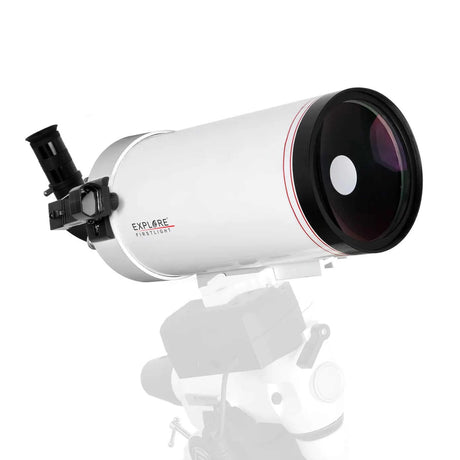
Catadioptric telescopes combine a corrector lens with mirrors to fold the light path. The two common types are the Schmidt-Cassegrain and the Maksutov-Cassegrain, which has a glass corrector at the front and two mirrors inside. The result is a long focal length in a short tube: the 127 mm Maksutovs we carry have a 1,900 mm focal length. Long focal ratios, typically f/10 to f/15 on a Maksutov, suit the high magnification that the Moon and planets need.
What the design trades
The long focal length also gives a narrower field than a short refractor or reflector, so a Maksutov frames the Moon and planets better than wide star fields. In return it is compact, and like a refractor it is aligned at the factory and rarely needs collimation.
The three we carry
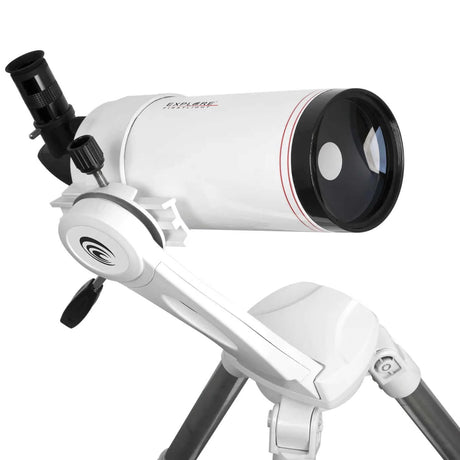
- Explore FirstLight 100mm f/14: a 1,400 mm focal length, sold as a complete set on the Twilight Nano mount.
- Explore FirstLight 127mm f/15: the optical tube alone, with a 1,900 mm focal length at 7.6 lb, for a mount you already own.
- Explore Scientific Sidara Pro 127: the same aperture and focal length on the Sidara Pro GoTo mount, which finds and tracks objects through the SkyAssist app or its hand controller.
Frequently Asked Questions
Is a Maksutov good for a beginner?
Yes, especially for the Moon and planets. It holds its alignment, packs into a short tube and gives high magnification with ordinary eyepieces.
Do Maksutovs need collimation?
Rarely. Like refractors, they are aligned at the factory and seldom need attention unless the telescope is damaged.
What magnification will I get?
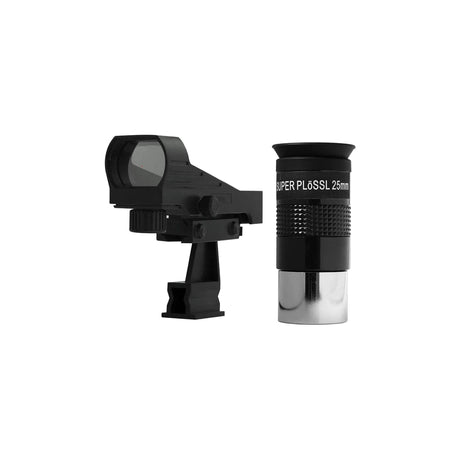
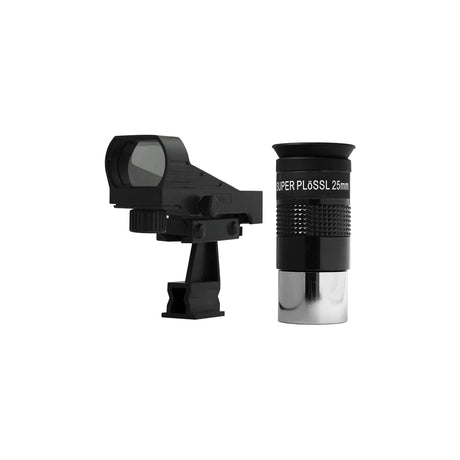
Divide the telescope's focal length by the eyepiece's. On a 1,900 mm Maksutov, a 25 mm eyepiece gives 76x and a 10 mm gives 190x, inside the 127 mm aperture's useful limit of about 254x.
For the Sidara Pro 127 alongside the rest of the line, read Explore Scientific Sidara Telescopes Compared, and for what the planets need, Minimum Telescope Size to See Saturn's Rings Clearly.