



Why choose an 8x42
At 8x you see 15 to 25 percent more of the scene than at 10x, and small hand movements barely disturb the image, so finding and following a bird in cover is easier. The 5.25 mm exit pupil matches a dilated eye better than a 10x42's 4.2 mm, which keeps the view brighter in the last light. Choose a 10x42 instead if you mostly watch at distance in open country.
How the 8x42s we carry differ
Field of view
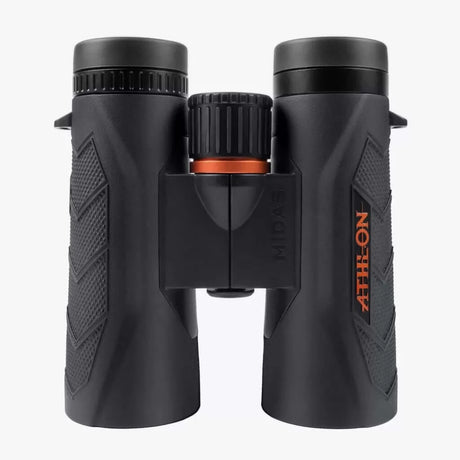
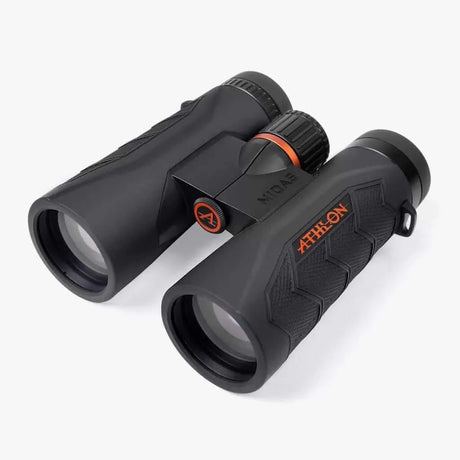
The Kite Lynx HD+ shows 453 ft at 1,000 yards, and the Athlon Midas G2 UHD and the Alpen Apex and Apex XP 426 ft, against 345 ft on the Alpen Kodiak.
Close focus and weight
If you watch butterflies or feeder birds, look at close focus: the Midas G2 UHD and the Alpen Apex and Apex XP focus to 6.5 ft and the Steiner Predator and Kite Lynx HD+ to 6.6 ft, while several others need 13 ft or more. Weight varies as much: the Hawke Vantage weighs 19.6 oz, the Midas G2 UHD 23.3 oz and the Alpen Apex 36.8 oz.
Glass
ED glass, in the Alpen Chisos and Apex XP and the Explore Scientific G600, cuts color fringing at high-contrast edges, as does Athlon's UHD grade in the Argos G2 UHD and Midas G2 UHD.
Frequently Asked Questions
Are 8x42 binoculars good for glasses wearers?
Usually. Glasses wearers need at least 15 to 16 mm of eye relief, an 8x42 tends to have more than a 10x42, and most of ours list 17 mm or more.
Is 8x42 or 8x32 better?
In daylight they are close: field of view depends on the eyepiece, not the objective, and a 32 mm is 25 to 28 percent lighter. The 8x42 earns its weight at dawn and dusk and is more forgiving of where your eye sits.
Are 8x42s good for hunting?
In timber, treestands and close still-hunting, yes: you want a wide field to catch movement and a steady image you can hold one-handed. In open country a 10x42 adds the reach.
To see what a smaller binocular gives up, read 8x32 vs 8x42 Binoculars, and for hunting picks by terrain, Best Hunting Binoculars 2026.