This Week's Bonus Savings
Apply your 5% off code at checkout through November 15:


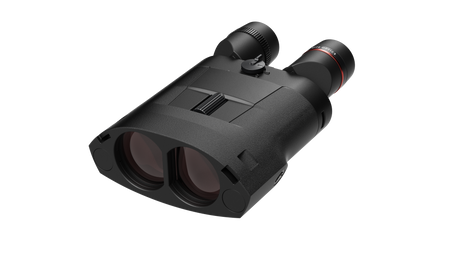
Kite Optics APC Stabilized 18x50 ED AA Binoculars
Kite Optics APC Stabilized 18x50 ED AA Binoculars is backordered and will ship as soon as it is back in stock.
Shipping & Returns
Shipping & Returns
We offer free US standard shipping on orders over $99 and 30-day returns on most items. Some limitations apply.
Shipping Policy
30-Day Return Policy

The Kite Optics APC 18x50 ED AA puts 18x magnification on Kite's second-generation KDGS-2 gimbal, behind 50 mm ED optics sealed to IPX7, and runs it for up to 38 hours on two AA batteries. Sig Sauer's Zulu6 HDX Pro 18x50 matches its 3.7° field, 2° stabilization angle, IPX7 rating and AA power, and Sig lists it lighter (33.97 oz to the Kite's 35.98 oz) with up to 40 hours of runtime. Canon's 18x50 IS All Weather matches the field and the AA cells and adds a doublet field flattener, but weighs 1,180 g to the Kite's 1,020 g (both without batteries), carries a JIS level 4 water resistance rating rather than IPX7, and Canon rates its battery life at about 2.5 hours at 25 °C.

Key Features
- KDGS-2 gimbal and KT 3.0 software. Kite introduced the KDGS-2, the second generation of its gimbal, in 2024 and runs it with its KT 3.0 processor and software. The KDGS (Kite Dynamic Gimbal System) is a gimbal suspension in which an array of accelerometers continuously assesses every moving and non-moving component, and the balance it works toward lets the system remove both small and large movements from the image while adapting to fast panning or scanning of the sky and horizon. Kite USA rates the correction angle at 2°, wider than the ±0.7° Canon publishes for the 18x50 IS All Weather.
- A wide view at 18x. The 18x50 has a 61° apparent field that meets ISO standards for wide-angle binoculars. Its real field is 3.7°, or 195 ft at 1,000 yards: the same as the APC 14x50, which spreads it across a 49° apparent field.
- ED glass, 86% light transmission. The ED glass reduces chromatic aberration, a protective repellent coating finishes the optics, and light transmission is rated at 86% with its MHR Advance+ coatings.
- Two AA batteries, up to 38 hours. One AA goes in each side, under covers you turn anticlockwise to open. Kite recommends lithium AAs over alkaline for battery life and a low risk of leakage; rechargeable cells are not supported unless Kite supplies or explicitly recommends them. When you switch on, a steady status light means 100% to 30% charge, and orange blinking means less than 30%. Testing both versions of the 18x50 for Binomania, Piergiovanni Salimbeni found both at 80% battery life after 15 days of really heavy use.
- Stabilization that wakes when you raise it. Kite's APC (angle power control) puts the stabilizing electronics to sleep when the binocular rests near vertical, hanging from your neck or standing on a table, and wakes them when you raise it to observe, with no button to press. Ninety minutes after you switch it on, the binocular turns itself off; switch it off and on again to restart.
- Usable on flat batteries. In the OFF position the power switch locks the gimbal, so with no batteries, or flat ones, the APC works as a conventional 18x50.
- Sealed for weather, made in Japan. The APC 50 is rated IPX7 waterproof, able to withstand submersion to 1 meter, and it is nitrogen-filled with sealed electronics. It is made in Japan.
- Eyecups and diopter. The eye relief is 15.5 mm; leave the twist-up eyecups down when you observe with glasses. The diopter ring on the right eyepiece corrects ±3.
Who It's For
- Birders on estuaries, reservoirs and seawatches, where the bird is far off and the alternative is a spotting scope on a tripod.
- Hunters glassing open country who want 18x from the hand, with a tripod socket for a long sit.
- Boat users and sea watchers, for whom the IPX7 rating and the 1-meter submersion rating matter as much as the stabilizer.
- Choosing within the APC 50 line. The APC 18x50 ED Li-ion has the same optics with a built-in battery that charges over USB and runs up to 30 hours, and costs a little more. The APC 14x50 ED AA and APC 14x50 ED Li-ion give up magnification for a 3.5 mm exit pupil, about 1.6 times the image brightness of this model's 2.77 mm once your pupils open at dusk, and 18 mm of eye relief. For less weight, the APC 16x42 AA weighs 25.9 oz and has room for two spare AA cells, but has no tripod socket.
- Cross-shopping our other stabilized binoculars. Alpen's Apex Steady 20x42 reaches 20x at 644 g and costs less. The APC's 50 mm objectives gather (50 ÷ 42)² = 1.4 times the light, its exit pupil is 2.77 mm to the Alpen's 2.1, and it adds IPX7 sealing (the Alpen is IPX4) and a tripod socket the Alpen lacks. Browse them all in stabilized binoculars.
Accessories & Compatibility
- Tripod. A 1/4-inch tripod socket takes it onto a tripod for long sessions.
- Silicone jacket. Kite's silicone jacket for the APC 50 comes in full black and sage green.
- Batteries. Two AA cells, not included.
-
Magnification
-
Objective Lens Diameter
-
Battery Life
-
Field of View
-
Exit Pupil
-
Eye Relief
-
Close Focus
-
Weight
-
Water Resistance Level
-
Fog-proof
-
Optical Glass Type
-
Lens Coating
-
Prism System
-
Twilight Factor
-
Dimensions
-
Other Details
-
Warranty
-
Item Number
Payment & Security
Payment methods
Your payment information is processed securely encrypted during transmission. We do not store credit card details nor have access to your credit card information.
Compare Kite APC 50 Stabilized Binoculars
| Facet | |||||
|---|---|---|---|---|---|
| Price | |||||
| Price |
Sale price
$1,749.00
Regular price
$1,849.00
Unit price
|
Sale price
$1,799.00
Regular price
$1,899.00
Unit price
|
Sale price
$1,799.00
Regular price
$1,899.00
Unit price
|
Sale price
$1,849.00
Regular price
$1,999.00
Unit price
|
Sale price
$1,899.00
Regular price
$1,999.00
Unit price
|
| Magnification | |||||
| Magnification | |||||
| Objective Lens Diameter | |||||
| Objective Lens Diameter | |||||
| Field of View | |||||
| Field of View | |||||
| Exit Pupil | |||||
| Exit Pupil | |||||
| Eye Relief | |||||
| Eye Relief | |||||
| Twilight Factor | |||||
| Twilight Factor | |||||
| Battery Life | |||||
| Battery Life | |||||
| Weight | |||||
| Weight | |||||