This Week's Bonus Savings
Apply your 5% off code at checkout through November 15:


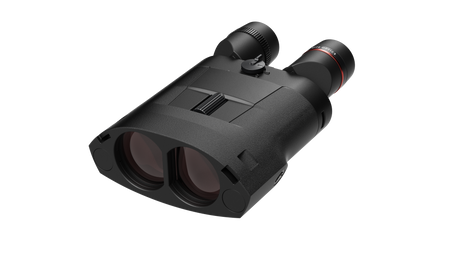
Kite Optics APC Stabilized 14x50 ED Li-Ion Binoculars
Kite Optics APC Stabilized 14x50 ED Li-Ion Binoculars is backordered and will ship as soon as it is back in stock.
Shipping & Returns
Shipping & Returns
We offer free US standard shipping on orders over $99 and 30-day returns on most items. Some limitations apply.
Shipping Policy
30-Day Return Policy

The Kite Optics APC 14x50 ED Li-ion pairs 14x magnification on Kite's KDGS-2 gimbal with the largest exit pupil (3.5 mm) and the longest eye relief (18 mm) in Kite's APC 50 line, powered by a built-in battery that charges over USB-C and runs up to 30 hours. Sig Sauer's Zulu6 HDX Pro 14x50 matches its 3.7° field, 2° stabilization angle and IPX7 rating; Sig lists it lighter (33.61 oz to the Kite's 35.59 oz) and rates it for up to 40 hours on two AA cells, where the Kite charges from a USB adapter or a power bank. Alpen's Apex Steady 14x42 costs less, weighs 644 g to the Kite's 1,009 g and shows a wider field (210 ft at 1,000 yards to 195 ft), while the Kite's 50 mm objectives gather (50 ÷ 42)² = 1.4 times the light and it is rated IPX7 to the Alpen's IPX4.

Key Features
- KDGS-2 gimbal and KT 3.0 software. Kite introduced the KDGS-2, the second generation of its gimbal, in 2024 and runs it with its KT 3.0 processor and software. The KDGS (Kite Dynamic Gimbal System) is a gimbal suspension in which an array of accelerometers continuously assesses every moving and non-moving component, and the correction angle is rated at 2°. Best Binocular Reviews, in Jason Whitehead's review of the APC 14x50, gave it the site's "Best Image Stabilization Binoculars 2024" award.
- Brighter at first and last light. Once your pupils open in dim light, the 3.5 mm exit pupil gives about 1.6 times the image brightness of the APC 18x50's 2.77 mm; the twilight factor still favors the 18x50 for fine detail (30 against 26.5). Both models share a 3.7° real field, 195 ft at 1,000 yards, which the 14x50 spreads across a 49° apparent field.
- ED glass, 86% light transmission. The ED glass reduces chromatic aberration, a protective repellent coating finishes the optics, and light transmission is rated at 86% with its MHR Advance+ coatings.
- Built-in battery, charged over USB-C. A full charge is rated at 30 hours, enough with the APC power saving for up to two months of intensive use or six months of average use. Kite recommends a USB adapter of at least 1.5 A at 5 V for the best charging time, and a power bank works too; the status light shows orange while charging and green when full. When you switch on, it blinks three times above 80% charge, twice from 80% to 50% and once from 50% to 20%, and blinks orange below 20%. The battery is built in and cannot be replaced.
- Stabilization that wakes when you raise it. Kite's APC (angle power control) puts the stabilizing electronics to sleep when the binocular rests near vertical, hanging from your neck or standing on a table, and wakes them when you raise it to observe, with no button to press. Ninety minutes after you switch it on, the binocular turns itself off; switch it off and on again to restart.
- Usable on a flat battery. In the OFF position the power switch locks the gimbal, so with a flat battery the APC works as a conventional 14x50.
- Built for the weather. The APC 50 is rated IPX7 waterproof, able to withstand submersion to 1 meter, and it is nitrogen-filled with sealed electronics. It operates from -20 °C to +45 °C and charges from 10 °C to 45 °C, and Kite recommends charging the battery once every six months in storage. It is made in Japan.
Who It's For
- Pelagic and coastal birders. Birdquest's guides chose the 14x50 to test on coastal watches and pelagic trips, and found it makes a profound difference to studying and identifying birds when both the boat and the sea are moving.
- Eyeglass wearers. With 18 mm of eye relief, leave the twist-up eyecups down when you observe with glasses; the diopter ring on the right eyepiece corrects ±3.
- Observers at dawn and dusk who would rather have the brighter image than the last step of magnification.
- Choosing within the APC 50 line. The APC 14x50 ED AA has the same optics on two AA cells rated for up to 38 hours, and costs less. The APC 18x50 ED Li-ion and APC 18x50 ED AA reach 18x across a 61° apparent field, with 15.5 mm of eye relief. For the same 3.5 mm exit pupil in a lighter body, the APC 12x42 AA weighs 25.4 oz but has no tripod socket. Browse them all in stabilized binoculars.
Accessories & Compatibility
- Charging. The box includes the USB-C cable but no wall adapter; a USB adapter or a power bank charges it.
- Tripod. A 1/4-inch tripod socket takes it onto a tripod for long sessions.
- Silicone jacket. Kite's silicone jacket for the APC 50 comes in full black and sage green.
-
Magnification
-
Objective Lens Diameter
-
Battery Life
-
Field of View
-
Exit Pupil
-
Eye Relief
-
Close Focus
-
Weight
-
Water Resistance Level
-
Fog-proof
-
Optical Glass Type
-
Lens Coating
-
Prism System
-
Twilight Factor
-
Dimensions
-
Other Details
-
Warranty
-
Item Number
Payment & Security
Payment methods
Your payment information is processed securely encrypted during transmission. We do not store credit card details nor have access to your credit card information.
Compare Kite APC 50 Stabilized Binoculars
| Facet | |||||
|---|---|---|---|---|---|
| Price | |||||
| Price |
Sale price
$1,749.00
Regular price
$1,849.00
Unit price
|
Sale price
$1,799.00
Regular price
$1,899.00
Unit price
|
Sale price
$1,799.00
Regular price
$1,899.00
Unit price
|
Sale price
$1,849.00
Regular price
$1,999.00
Unit price
|
Sale price
$1,899.00
Regular price
$1,999.00
Unit price
|
| Magnification | |||||
| Magnification | |||||
| Objective Lens Diameter | |||||
| Objective Lens Diameter | |||||
| Field of View | |||||
| Field of View | |||||
| Exit Pupil | |||||
| Exit Pupil | |||||
| Eye Relief | |||||
| Eye Relief | |||||
| Twilight Factor | |||||
| Twilight Factor | |||||
| Battery Life | |||||
| Battery Life | |||||
| Weight | |||||
| Weight | |||||