
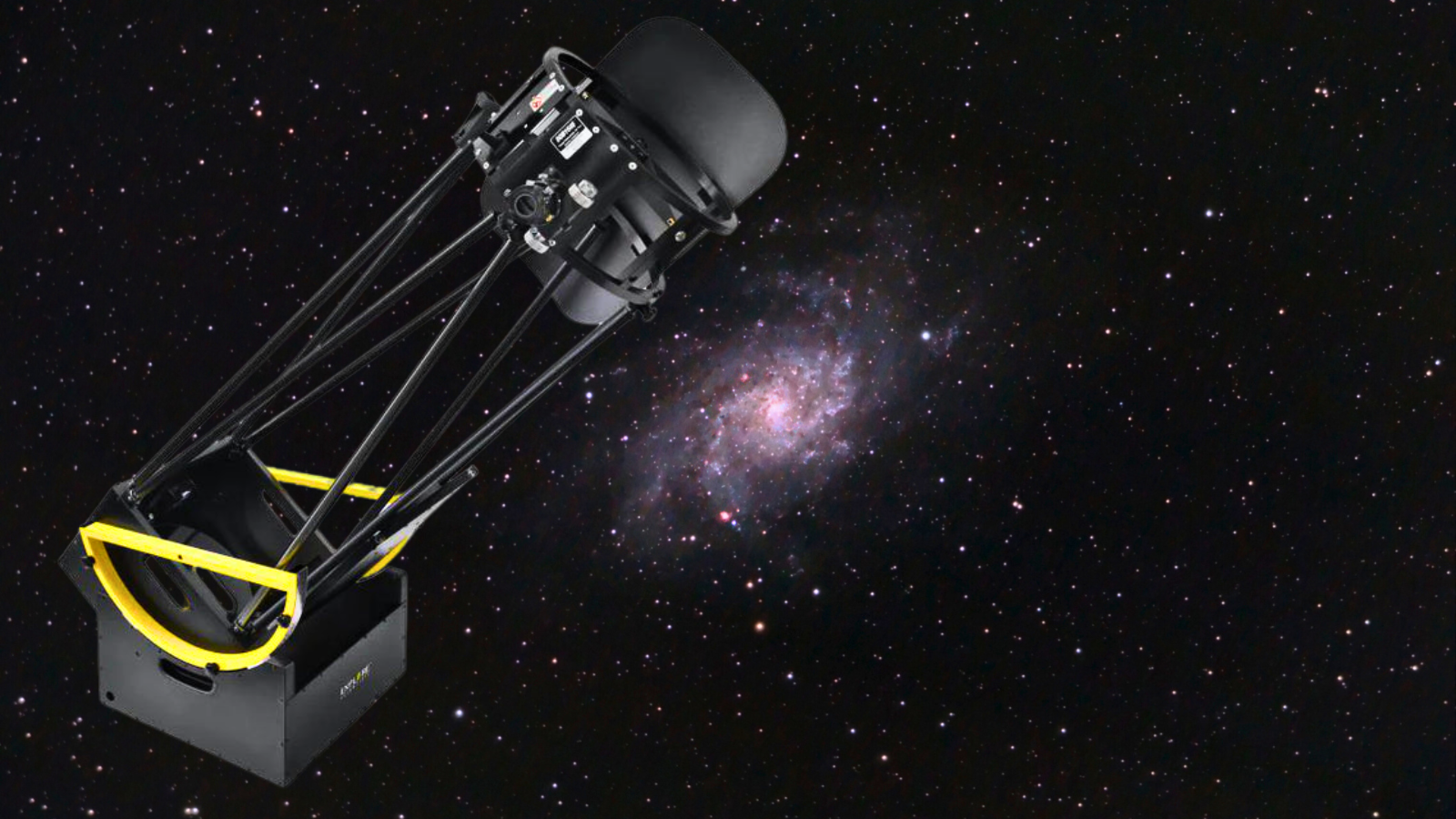
Update, October 2026: Explore Scientific has discontinued this telescope and the rest of its Generation II truss tube series, so we can no longer supply it. We’ve kept this review up for owners and for anyone weighing a 16-inch Dobsonian. The largest Dobsonians we now carry are 10-inch models, such as the Explore Scientific 10" f/5 Hybrid Truss Tube Dobsonian.
TL;DR — Quick Summary
The Explore Scientific 16-inch Dobsonian (16" f/4.5 Truss Tube, now discontinued) collects about 3,400 times more light than the naked eye (against a 7mm dark-adapted pupil), four times more than an 8-inch scope. Its truss tube design breaks down for transport (heaviest piece: 66 lbs), assembles tool-free in about 10 minutes, and dual cooling fans help the primary mirror reach thermal equilibrium faster. At $3,599.99, it was a serious investment. But for observers ready to move beyond what an 8" or 12" can show, the aperture jump is transformative.
A 16-inch Dobsonian gathers four times the light of an 8-inch. If you’ve spent a few seasons with a mid-size scope and found yourself wishing for more detail in galaxies, more structure in nebulae, or more stars resolved in globular clusters, this is the logical next step. The Explore Scientific 16" f/4.5 Truss Tube Dobsonian packs serious aperture into a design that actually fits in your car.
This article covers what the telescope delivers, what it doesn’t, and whether the upgrade from a smaller scope justifies the price.
Table of Contents
- Why 406mm of Aperture Changes Everything
- How Does It Compare to Smaller Dobsonians?
- Real-World Performance
- What’s Inside the Box — And What’s Not
- Key Specifications
- Design and Build Quality
- Is a 16-Inch Dobsonian Portable?
- Essential Tips for New 16-Inch Dobsonian Owners
- Our Verdict
- Frequently Asked Questions
Why 406mm of Aperture Changes Everything
Aperture — the diameter of the primary mirror — determines how much light a telescope can gather. A 16-inch (406mm) mirror collects about 3,400 times more light than the unaided eye (against a 7mm dark-adapted pupil), with a theoretical limiting magnitude of 15.74 and a Rayleigh resolution limit of 0.34 arcseconds.
To put that in context: a typical 8-inch Dobsonian gathers about 25% of the light that a 16-inch collects. That’s a 4x difference in light-gathering area. A 12-inch gathers about 56% — roughly 1.8x less. These aren’t incremental improvements. They’re the difference between glimpsing a smudge and tracing the spiral arms of a galaxy.

With a 16-inch mirror, faint objects that were invisible or featureless through smaller scopes become genuinely interesting targets. The Whirlpool Galaxy (M51) shows defined spiral structure. The Veil Nebula reveals intricate filaments with a UHC or O-III filter. Globular clusters like M13 resolve into individual stars nearly to the core.
How Does It Compare to Smaller Dobsonians?
Explore Scientific’s Generation II truss tube series ran from 10 to 20 inches, and all four sizes are now discontinued. Here’s how they compared:
| Specification | 10" f/5 Truss | 12" f/5 Truss | 16" f/4.5 Truss | 20" f/3.6 Truss |
|---|---|---|---|---|
| Aperture | 254mm | 305mm | 406mm | 500mm |
| Focal Length | 1270mm | 1525mm | 1826mm | 1826mm |
| Light vs. 8" (203mm) | 1.56x | 2.25x | 4.0x | 6.05x |
| Max Magnification | 500x | 600x | 800x | 1000x |
| Limiting Magnitude | ~14.7 | ~15.1 | 15.74 | ~16.2 |
The jump from 12" to 16" gains you about 1.8 times the light-gathering area, which translates directly into fainter objects, more structure in extended nebulae, and tighter resolution on planetary detail. The jump from 16" to 20" is proportionally smaller (1.52x), and the 20" was substantially heavier and sold for $9,999.99.
For most observers upgrading from an 8" or 10", the 16-inch sits in a sweet spot: a genuinely transformative aperture increase without crossing into observatory-scale logistics.
Real-World Performance
Deep-Sky Objects
This is where the 16-inch earns its keep. With four times the light of an 8-inch, faint galaxies and nebulae go from "barely there" to visually compelling:
- Galaxies: M51 (Whirlpool) shows well-defined spiral arms. M31 (Andromeda) reveals dust lanes. M104 (Sombrero) shows a clear dark lane bisecting the disk. NGC 4565 (Needle Galaxy) extends as a thin streak with a central bulge.
- Nebulae: The Veil Nebula (NGC 6960/6992) becomes a showpiece with an O-III filter, filling the eyepiece with filamentary structure. M42 (Orion Nebula) shows extensive detail in the wings. M8 (Lagoon) and M1 (Crab) both benefit from the extra aperture.
- Globular clusters: M13 (Hercules) and M22 resolve into a dazzling field of individual stars nearly to the core. Fainter globulars like M79 — an easy fuzzy patch in 10x50 binoculars, but stubbornly unresolved in small scopes — begin to break into individual stars around their edges.
Filter tip: at f/4.5, narrowband filters like O-III and UHC work well for emission nebulae. The filters block most of the sky background while passing the nebula’s emission lines, and the contrast boost is especially effective at this aperture.
Planets and the Moon
While deep-sky is the primary strength, the 16-inch also delivers on planets when atmospheric seeing cooperates:
- Jupiter: The Great Red Spot, multiple cloud bands, festoons, and all four Galilean moons with visible disk shapes at high magnification.
- Saturn: The Cassini Division is obvious. On steady nights, the Encke Minima — a subtle, broad darkening about midway across the A ring — becomes apparent, along with cloud banding on the disk. (Not to be confused with the Encke Gap, a far narrower true division near the ring’s outer edge and a much harder target.)
- Mars: During opposition, polar ice caps and major surface features (Syrtis Major, Hellas Basin) are clearly visible.
- Moon: Craters like Tycho show central peaks and ray systems. Rilles along Mare Imbrium are traceable. The view is almost overwhelming in detail.
Realistic Expectations
The theoretical limiting magnitude of 15.74 assumes perfect conditions. In practice, under dark skies (Bortle 3–4), expect to reach magnitude 14 to 15. Light pollution, atmospheric transparency, and thermal equilibrium all factor in. Objects will look monochrome and subtle through the eyepiece — nothing like long-exposure astrophotos. But the detail is real, and at 16 inches, you’re seeing structure that smaller scopes simply cannot reveal.
What’s Inside the Box — And What’s Not
The Explore Scientific 16" f/4.5 (ES-DOB1645-01) includes:
- Two-speed 2" rack-and-pinion focuser with 10:1 fine adjustment and 1.25" adapter
- LED red dot finder
- Collimation assist tool
- Flexible lightweight light baffle
- Two primary mirror cooling fans
- Assembly instructions
Not included: eyepieces, light shroud, or counterweights. At $3,599.99, the absence of eyepieces was notable, so budget for them. You’ll also want these accessories from the start:
- Light shroud: Blocks stray light from entering the open truss, improves contrast, and keeps dust off the optics. Strongly recommended.
- Coma corrector: At f/4.5, coma is noticeable at the edges of wide-field views. A coma corrector eliminates this distortion.
- 12V battery power supply: A portable power source for the cooling fans in the field. Explore Scientific offers a battery pack, or any 12V DC supply with a matching 5.5 x 2.1mm barrel connector and correct polarity works.

Key Specifications
| Specification | Value |
|---|---|
| Aperture | 406mm (16") |
| Focal Length | 1826mm |
| Focal Ratio | f/4.5 |
| Dawes Limit | 0.29 arcseconds |
| Rayleigh Limit | 0.34 arcseconds |
| Limiting Magnitude | 15.74 (theoretical) |
| Maximum Magnification | 800x (theoretical) |
| Secondary Obstruction | 25% |
| Mirror Cell | 9-point support |
| Focuser | 2" rack-and-pinion, 10:1 fine adjustment |
| Total Weight | 88.1 lbs (mirror box and rocker box only) |
| Mirror Box Weight | 66 lbs |
| Secondary Cage Weight | 8 lbs |
| Truss Pole Length | 140 cm (55.1") |
| Eyepiece Height at Zenith | 167 cm (66") |
| Warranty | Limited lifetime (ES-branded); 2 years on electronics (cooling fans, red dot finder). Non-transferable, original purchaser only, proof of purchase required; register within 60 days. |
| Last price | $3,599.99 |
Design and Build Quality
Truss Tube Architecture
The telescope breaks down into four main sections: the mirror box (housing the 406mm primary), the secondary cage (holding the secondary mirror, focuser, and finder), eight aluminum truss poles that connect them, and the rocker box the mirror box sits in. The poles are arranged in four hinged pairs, reducing parts count. Assembly is entirely tool-free — the truss poles slide into slots on the mirror box and secure to the secondary cage with thumbscrew knobs.

Precision Focuser and Optics
The 2" rack-and-pinion focuser features a 10:1 fine adjustment ratio for precise focus control — critical when observing at higher magnifications. The 406mm parabolic primary mirror sits in a nine-point support cell that prevents flexure and maintains optical alignment across different pointing angles. The secondary mirror has a 25% central obstruction, which is typical for this class of Newtonian reflector.
The mirror coating is standard aluminum with a protective overcoat. This is functional and durable, though some competitors (like the Apertura AD16) offer 96% enhanced aluminum coatings that reflect slightly more light.

Cooling and Thermal Management
A 16-inch glass mirror has significant thermal mass. If the mirror is warmer than the ambient air, convection currents inside the tube degrade image quality. The Explore Scientific addresses this with dual radial cooling fans mounted on the back of the mirror box. One pushes air into the mirror box and across the mirror surface while the other pulls warm air out, reducing cool-down time from several hours (passive) to roughly 30 minutes or less under typical conditions.
The open truss tube design also helps — ambient air circulates freely around the mirror, which is an advantage over closed-tube reflectors.

Bearings and Tracking
The rocker box uses smooth altitude and azimuth bearings for manual tracking. Well-designed bearings are essential for a Dobsonian this size — the telescope needs to stay put when you let go and move smoothly when you nudge it. In BBC Sky at Night Magazine’s 2015 review, the large altitude wheels gave "a smooth and positive feel" for small movements at high magnification, though balance-sensitive users may want counterweights when using heavy eyepieces or binoviewers.

Is a 16-Inch Dobsonian Portable?
More portable than you’d expect. The truss tube design was specifically engineered for transport:
- Mirror box (heaviest component): 66 lbs, with a footprint of about 55 × 55 cm (21.7" × 21.7")
- Secondary cage: 8 lbs, 48 cm (18.9") outer diameter
- Total weight: 88.1 lbs for the mirror box and rocker box alone (Explore Scientific’s figure); the secondary cage and truss poles add to that
- Truss poles: 140 cm (55") long, 25 mm diameter, stored as hinged pairs
The mirror box fits through a standard doorway and on the back seat of many cars. One owner’s Cloudy Nights user review puts first assembly at "about 20 mins or so" and a later setup at a dark site at "10 mins," plus 5 minutes to collimate.
The eyepiece sits at 167 cm (66") at zenith, which is above the standing eye height of most adults, so many observers will want a low step stool for targets near the zenith. For targets near the horizon, a step stool isn’t needed.
Collimation needs to be checked every session after assembly — the included collimation assist tool makes this a 2–5 minute process. BBC Sky at Night Magazine’s review found that "even after transporting and assembling the telescope several times, the optics required only minor adjustment."
Essential Tips for New 16-Inch Dobsonian Owners
- Use a light shroud every session. The open truss lets in stray light that degrades contrast. A shroud also protects optics from dew.
- Check collimation after every assembly. Truss tube Dobs shift slightly during transport. The included tool makes this quick.
- Turn on the cooling fans as soon as you set up. The mirror will never fully equilibrate on a night where temperatures keep falling, so start early.
- Invest in a coma corrector for wide-field views. At f/4.5, coma (star elongation toward the edges) is visible with wide-field eyepieces. A coma corrector restores pinpoint stars across the field.
- Use counterweights with heavy accessories. The balance point is sensitive. Heavy eyepieces or binoviewers can cause the tube to drift in altitude.
- Number your truss poles. Reassembling poles in the same positions each time maintains more consistent collimation.
Our Verdict
The 16-inch Dobsonian is built for one thing: showing you more of the universe than a smaller telescope can. If you’ve been observing for a while and know what you want to see — fainter galaxies, resolved globular cores, delicate nebula filaments — this delivers.
This telescope is a strong fit if you:
- Have experience with a smaller scope (8–12") and want a genuine aperture upgrade
- Prioritize visual deep-sky observing
- Can handle the weight and storage of a 66-lb mirror box
- Have access to reasonably dark skies (Bortle 4 or better)
- Are comfortable with routine collimation
Consider starting with a smaller scope if you:
- Are new to astronomy and still learning to navigate the sky
- Need a grab-and-go telescope for quick sessions
- Don’t have transport for the weight and size
- Observe primarily from a light-polluted suburban backyard
The Explore Scientific 16" f/4.5 Truss Tube Dobsonian last sold for $3,599.99 before it was discontinued. It carries Explore Scientific’s Limited Lifetime Warranty against defects in materials and workmanship, with a 2-year limited warranty on the electronic components (the dual mirror cooling fans and the LED red dot finder). Coverage is for the original purchaser only and is non-transferable, requires proof of purchase from an authorized Explore Scientific dealer, is valid in the USA only, and should be registered within 60 days of purchase to activate.
For observers ready to make the jump to serious aperture, the 16-inch Dobsonian opens a part of the sky that smaller telescopes can only hint at.
Related Guides
- 8" vs 10" Dobsonian: Which One Should You Buy? — If you're deciding whether to start with a smaller Dobsonian before committing to 16 inches, this comparison covers the trade-offs.
- Telescope Buyer's Guide — Not sure a Dobsonian is the right type for you? Compare refractors, reflectors, and catadioptrics side by side.
- Browse All Dobsonians — See the Dobsonians we carry today.
Frequently Asked Questions
Can beginners use a 16-inch Dobsonian?
Yes, but with a learning curve. The telescope itself is straightforward to operate — tool-free assembly, manual tracking, and an included collimation tool simplify the process. However, beginners may find the weight (66-lb mirror box), collimation routine, and sky navigation challenging without prior experience. Most observers benefit from learning on a smaller scope first, then upgrading to the 16-inch once they’re comfortable finding targets and maintaining a reflector.
How long does it take to set up a truss tube Dobsonian?
About 10 minutes for experienced users, plus a few minutes to check collimation. First-time assembly takes roughly 20 minutes as you learn how the truss poles, mirror box, and secondary cage fit together. Add another 30 minutes for the cooling fans to bring the primary mirror to thermal equilibrium.
Do I need to collimate every time I observe?
Yes, you should check collimation after each assembly. The truss tube design means the secondary cage is removed and reattached every session, which can introduce small alignment shifts. The included collimation assist tool makes the check quick — typically 2 to 5 minutes. Most of the time, only minor tweaks are needed rather than a full realignment.
What eyepieces work best with a 16-inch f/4.5 Dobsonian?
A wide-field eyepiece in the 20–24mm range (giving roughly 76–91x magnification) is ideal for deep-sky scanning and framing large targets. For planetary detail, a 7–9mm eyepiece pushes magnification to 200–260x, where seeing conditions become the limiting factor. At f/4.5, eyepiece quality matters — shorter focal-ratio scopes are more demanding on eyepiece design. Pair wide-field eyepieces with a coma corrector to maintain sharp stars across the field.
Is astrophotography possible with this telescope?
Limited astrophotography is possible, but this telescope is primarily a visual instrument. The Dobsonian alt-azimuth mount does not track the sky, which limits exposures to very short durations. Planetary imaging with a high-frame-rate camera works well — the large aperture gathers plenty of light for fast video captures. Deep-sky astrophotography requires an equatorial tracking platform, which adds complexity and cost. Most 16-inch Dobsonian owners focus on visual observing.
How long does a 16-inch mirror take to cool down?
With the dual cooling fans running, expect roughly 30 minutes to reach usable thermal equilibrium for a temperature differential of about 10°C. Without fans, a mirror this size can take 2–3 hours to stabilize passively. The open truss tube design helps by allowing ambient air to circulate around the mirror. Start the fans as soon as you finish assembly — the earlier the mirror begins equilibrating, the better your views will be when full darkness arrives.