
TL;DR — Quick Summary
Thermal scopes with rangefinders — also called LRF scopes — combine thermal imaging, a laser rangefinder, and a ballistic calculator into one device — eliminating the need to juggle separate tools in the field. The premium over a non-LRF thermal scope is typically $300–$500, and for hunters who regularly shoot beyond 200 yards or hunt in variable terrain, it pays for itself in cleaner shots and fewer missed opportunities. Our picks: the Guide TU435L (MSRP $2,780) for the most affordable LRF scope with 50 Hz and IP68, the Alpen Apex 640 35mm LRF (MSRP $3,624.99) for the best value 640-resolution sensor, the Athlon Cronus ATS Pro 35L-400 (MSRP $3,874.99) for the most feature-complete package, or the Guide TU650M (MSRP $4,790) for a dual-channel thermal + night vision hybrid.
Table of Contents
- What Are Thermal Scopes with Rangefinders?
- How a Built-In Rangefinder Changes the Game
- Our Top Picks: Thermal Scopes with LRF
- LRF Thermal Scope Comparison
- Thermal Scopes Without LRF: When to Save
- What to Look For When Buying a Thermal Scope with Rangefinder
- Frequently Asked Questions
- Pick the Right Thermal Scope with Rangefinder for Your Hunt
What Are Thermal Scopes with Rangefinders?
Thermal scopes with rangefinders — commonly abbreviated as LRF (laser rangefinder) — combine two critical hunting technologies into a single optic. The thermal scope detects infrared radiation — heat — emitted by every object in the environment. Unlike night vision, which amplifies existing light, thermal imaging works in complete darkness, through fog, and in conditions where traditional optics are useless. You see heat signatures, not reflected light.
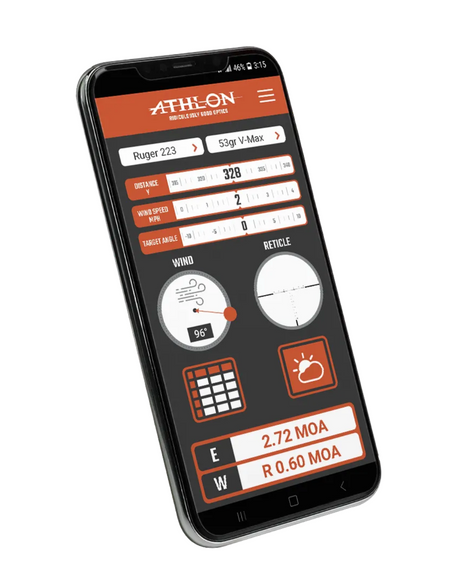
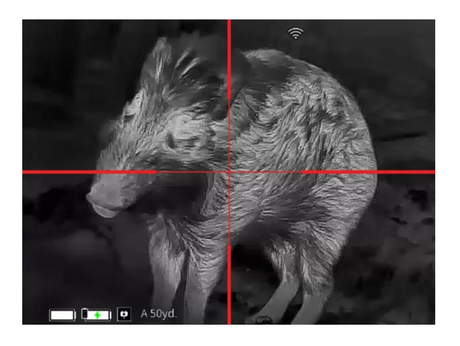
Adding a built-in laser rangefinder to this capability changes the workflow entirely. Press a button while looking through the scope, and you get an instant distance reading overlaid on your thermal image — no need to set down the rifle, pick up a separate rangefinder, and re-acquire your target. The best models feed that range data directly into an onboard ballistic calculator that adjusts your aiming point for bullet drop.
The question most buyers face is whether that integrated LRF is worth the $300–$500 premium over an otherwise identical thermal scope. This guide breaks down the practical advantages, covers the specs that matter, and recommends specific models at different price points — all available at dealer pricing well below MSRP.
How a Built-In Rangefinder Changes the Game
Spot, Range, Shoot — One Device
Without an integrated LRF, the sequence for a ranged shot goes like this: spot the target through your thermal scope, lower the rifle, pick up your rangefinder, range the target, put down the rangefinder, re-acquire the target, calculate holdover, and take the shot. That is a lot of movement, especially at night when you are working by feel.
With an integrated LRF, the sequence becomes: spot the target, press the range button on the scope, read the distance overlaid on your display, and shoot. One device. No fumbling. No unnecessary movement that could spook wary game.
This matters most for predator hunters calling coyotes — animals that appear suddenly, stay briefly, and bolt at the first sign of movement. The 5–10 seconds you save by not switching between devices is often the difference between a clean shot and an empty field.
Accuracy at Distance
Misjudging distance is one of the most common reasons for missed shots, and the error compounds dramatically beyond 200 yards. A 50-yard miscalculation at 300 yards can mean your bullet impacts 6–8 inches low — enough to wound an animal instead of making a clean kill, or miss entirely.
An LRF eliminates this guesswork. The laser provides distance accurate to plus or minus one yard, and the scope's ballistic calculator translates that into a corrected aiming point. No manual holdover estimation, no range cards, no mental math under pressure.
The LRF models in our lineup range targets from 1,000 meters to 1,600 yards — well beyond the practical shooting distance of any thermal scope. You will always have more ranging capability than you need.
Performance in Darkness and Adverse Weather
Thermal scopes already excel where other optics fail — complete darkness, dense fog, rain, and thick brush. Heat signatures remain visible regardless of lighting or weather conditions.
Adding an LRF to this capability means you can spot, identify, and accurately range a target in conditions where a hunter with traditional optics would be completely blind. The laser rangefinder operates independently of the thermal sensor, so ranging accuracy is unaffected by the thermal image quality.
One advantage that is easy to overlook: try operating a handheld rangefinder in the dark, in gloves, while maintaining awareness of your surroundings. It is not impossible, but it is significantly harder than pressing a button on the scope you are already looking through.
Our Top Picks: Thermal Scopes with LRF
Best Value with LRF: Alpen Apex 640 35mm

The Alpen Apex 640 35mm Thermal Scope with LRF delivers a 640x512 sensor — the highest resolution among our LRF-equipped 35mm scopes — at the lowest price point in the LRF category.
Key specs: 640x512 resolution, 12-micrometer pixel pitch, NETD ≤20 mK, 1x/2x/4x/8x digital magnification, 1,000-meter LRF range, 1,800-meter detection range, 6.5-hour battery life per battery (up to 15 hours with additional batteries), 5 zeroing profiles, 32 GB onboard storage, OLED display at 1440x1080, 6 color palettes, waterproof and shockproof, 608g.
MSRP $3,624.99 — check the product page for current dealer pricing.
The 640x512 sensor provides over 2.5 times the pixel count of 400-class sensors, producing sharper thermal images at every distance. The ≤20 mK NETD matches the best thermal sensitivity in our lineup, meaning cleaner images in low-contrast conditions like fog or cold weather. The trade-off versus the Athlon models is a shorter LRF range (1,000 meters vs. 1,600 yards), fewer zeroing profiles (5 vs. 10), and less onboard storage (32 GB vs. 128 GB). For hunters who shoot under 1,000 meters — which covers the vast majority of thermal hunting scenarios — the Alpen delivers 640-resolution performance at a price that undercuts every other LRF scope in our lineup.
Without the LRF: The Alpen Apex 640 line does not currently offer a 35mm non-LRF variant, but the Alpen Apex 640 50mm Thermal Scope (MSRP $3,749.99) provides a non-LRF option with a larger 50mm objective lens.
Best Overall with LRF: Athlon Cronus ATS Pro 35L-400

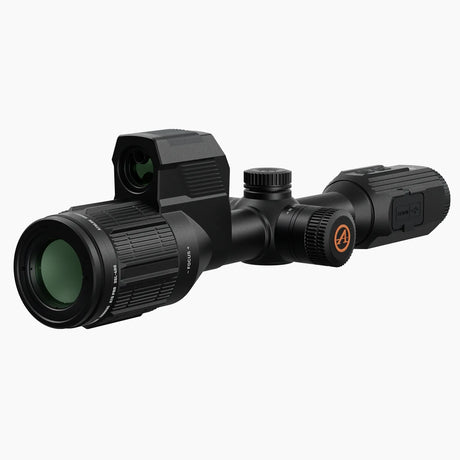
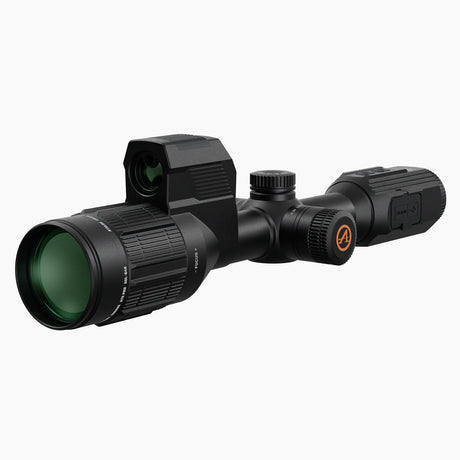
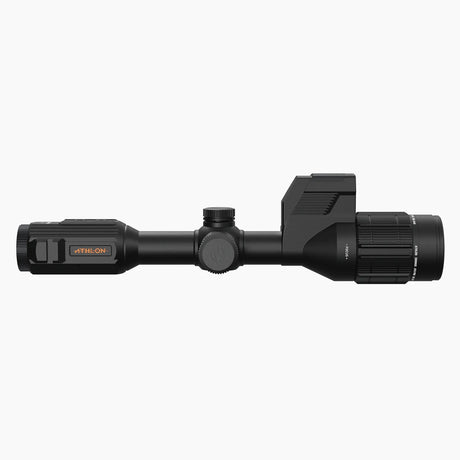
The Athlon Cronus ATS Pro 35L-400 is the most feature-complete LRF thermal scope in our lineup. Where the Alpen wins on sensor resolution, the Athlon wins on rangefinder reach, storage, and ballistic flexibility.
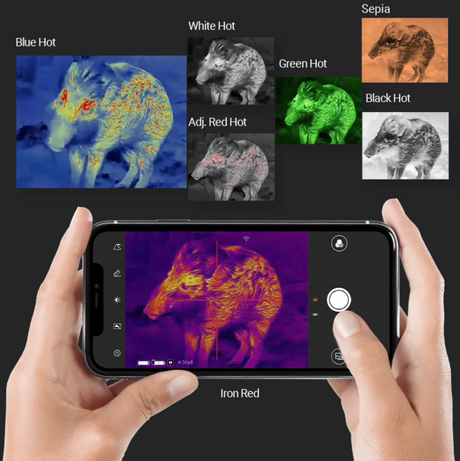
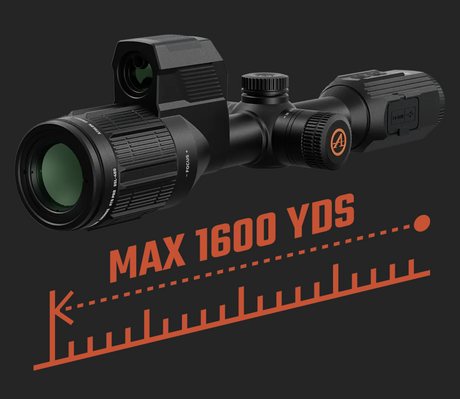
Key specs: 400x300 resolution, 12-micrometer pixel pitch, NETD ≤25 mK, 50 Hz refresh rate, 3.3x–13.2x magnification, LRF range 10–1,600 yards (±1 yard accuracy), 2,620-yard detection range, 1,090-yard recognition range, 10-hour battery life (1 built-in + 2 external batteries), 10 reticle patterns (5 MOA, 5 MIL) in 6 colors, 10 zeroing profiles, 128 GB onboard storage, IP67 waterproof, 0.49-inch OLED display at 1440x1080, 7 color palettes.
MSRP $3,874.99 — check the product page for current dealer pricing.
The 400x300 sensor is more than adequate for most hunting scenarios under 400 yards, which covers the vast majority of thermal hunting situations. The 50 Hz refresh rate provides noticeably smoother tracking than 30 Hz sensors when following moving targets. Ten zeroing profiles mean you can save settings for multiple rifles or ammunition types, and 128 GB of storage holds thousands of photos and hours of video. The 1,600-yard LRF range exceeds any practical thermal shooting distance.
Without the LRF: The same scope without a rangefinder is available as the Athlon Cronus ATS Pro 35-400 at MSRP $3,374.99 — a $500 savings. If you already own a quality handheld rangefinder and hunt at known distances, the non-LRF version delivers identical thermal imaging performance.
For the most budget-conscious Athlon option, the Cronus ATS Pro 35-400 with Picatinny Mount (MSRP $1,874.99) uses the same 400x300 sensor in a lighter, more compact package with a 0.39-inch display.
Best for Long Range: Alpen Apex 640 50mm LRF

The Alpen Apex 640 50mm Thermal Scope with LRF pairs a 640x512 sensor with a 50mm objective lens for the longest detection range in our LRF-equipped thermal lineup.
Key specs: 640x512 resolution, 12-micrometer pixel pitch, NETD ≤20 mK, 1x/2x/4x/8x digital magnification, 50mm F1.0 objective, 1,000-meter LRF range, 2,600-meter detection range, 6.5-hour battery life per battery (up to 15 hours with additional batteries), 5 zeroing profiles, 32 GB onboard storage, OLED display at 1440x1080, 6 color palettes, waterproof and shockproof, 632g.
MSRP $4,124.99 — check the product page for current dealer pricing.
The 50mm objective lens gathers significantly more infrared energy than a 35mm lens, extending detection range to 2,600 meters. Combined with the 640x512 sensor and ≤20 mK NETD, this scope delivers the sharpest thermal images at the longest ranges in our catalog. The 8.7-degree field of view provides a wide scanning area, and the 632g weight keeps the package remarkably light for a 50mm optic.
Without the LRF: The Alpen Apex 640 50mm Thermal Scope (MSRP $3,749.99) provides identical thermal imaging with the same 640x512 sensor and 50mm objective — a solid option if you prefer a separate rangefinder.
Maximum Resolution and Range: Athlon Cronus ATS Pro 50L-640

For hunters who want maximum features and the longest LRF range, the Athlon Cronus ATS Pro 50L-640 is the flagship of the Athlon thermal lineup.
Key specs: 640x480 resolution, 12-micrometer pixel pitch, NETD ≤20 mK, 50 Hz refresh rate, 2.95x–23.6x magnification, 50mm F1.0 objective, LRF range 10–1,600 yards (±1 yard accuracy), 2,620-yard detection range, 1,090-yard recognition range, 10-hour battery life, 10 reticle patterns (5 MOA, 5 MIL) in 6 colors, 10 zeroing profiles, 128 GB storage, IP67 waterproof, 0.49-inch OLED display at 1440x1080, 7 color palettes.
MSRP $5,624.99 — check the product page for current dealer pricing.
The Athlon 50L-640 combines everything: 640-class resolution, 50mm light-gathering, 50 Hz refresh rate, 1,600-yard LRF, 10 zeroing profiles, and 128 GB storage. The 2.95x–23.6x magnification range gives you more flexibility than any other scope in our lineup, from wide-field scanning at low power to detailed target identification at high magnification. The ≤20 mK NETD ensures clean images even in low-contrast conditions.
Without the LRF: The Athlon Cronus ATS Pro 50-640 at MSRP $5,124.99 delivers identical thermal imaging without the rangefinder — a $500 savings.
Most Affordable LRF Scope: Guide TU435L

The Guide TU435L 3.0 Thermal Riflescope with LRF is the least expensive LRF-equipped thermal scope in our lineup — and it does not cut corners to get there. Guide Sensmart's TU 3.0 platform delivers 50 Hz refresh rate, IP68 waterproofing, 1,500-meter LRF range, and a 1920x1080 AMOLED display at a price that undercuts every other LRF scope we carry.
Key specs: 400x300 resolution, 12-micrometer pixel pitch, NETD ≤20 mK, 50 Hz refresh rate, 4.4x–17.6x magnification, 35mm F1.0 objective, 1,500-meter LRF range, 1,800-meter detection range, 12-hour battery life, 128 GB onboard storage, IP68 waterproof, 0.49-inch AMOLED display at 1920x1080, 30mm tube, 780g (27.5 oz).
MSRP $2,780 — check the product page for current dealer pricing.
The 400x300 sensor is the same resolution class as the Athlon 35L-400, but the Guide ships with a higher-resolution display (1920x1080 vs 1440x1080), a higher waterproof rating (IP68 vs IP67), and a longer LRF range (1,500 meters vs 1,600 yards — effectively equivalent). The 12-hour battery life exceeds the Athlon's 10+ hours. The trade-off: fewer zeroing profiles and reticle options than the Athlon, and Guide Sensmart is a newer brand in the US market compared to the established Athlon warranty network.
The full Guide TU 3.0 LRF lineup scales from this 400-class model all the way up to the TU650P with an in-lens coaxial LRF and F0.9 lens ($4,890 MSRP) and the TU1250M with a 1280x1024 sensor ($7,790 MSRP) — see the comparison table below for the full range.
Best Dual-Channel: Guide TU650M (Thermal + Night Vision)

The Guide TU650M 3.0 Thermal & Night Vision Riflescope with LRF is the only scope in our lineup that combines thermal imaging, digital night vision, and a laser rangefinder in a single optic. Switch between thermal, digital NV (with IR illuminator), or a fused overlay of both — all without removing the scope from your rifle.
Key specs: 640x512 thermal sensor + 35mm F4.0 digital night vision channel, 12-micrometer pixel pitch, NETD ≤18 mK, 50 Hz refresh rate, 3.7x–30x magnification, 50mm F1.0 thermal objective, 1,500-meter LRF range, 2,600-meter detection range, 14-hour hot-swap battery, 256 GB onboard storage, IP68 waterproof, 1.03-inch AMOLED display at 2560x2560 (QHD), 30mm tube, 1,013g (35.7 oz).
MSRP $4,790 — check the product page for current dealer pricing.
The dual-channel design solves a real problem: thermal excels at detection (finding targets in darkness) but shows heat signatures, not surface detail. Digital night vision shows more visual detail but needs some ambient light or an IR illuminator. The TU650M gives you both. The 2560x2560 QHD display is the highest resolution in our thermal lineup, and the 256 GB storage holds far more video than any other model. The 14-hour hot-swap battery means you can replace batteries in the field without powering down.
The trade-off is weight (1,013g — nearly double the Alpen 50mm LRF at 632g) and price. For pure thermal hunting, the Alpen or Athlon models deliver excellent performance at lower weight. The TU650M is for hunters who want one scope that handles both thermal and NV scenarios without swapping equipment.
LRF Thermal Scope Comparison
| Spec | Guide TU435L | Alpen 35mm LRF | Athlon 35L-400 | Alpen 50mm LRF | Athlon 50L-640 | Guide TU650M |
|---|---|---|---|---|---|---|
| Sensor | 400x300 | 640x512 | 400x300 | 640x512 | 640x480 | 640x512 + Digital NV |
| NETD | ≤20 mK | ≤20 mK | ≤25 mK | ≤20 mK | ≤20 mK | ≤18 mK |
| Refresh Rate | 50 Hz | — | 50 Hz | — | 50 Hz | 50 Hz |
| Magnification | 4.4–17.6x | 1–8x digital | 3.3–13.2x | 1–8x digital | 2.95–23.6x | 3.7–30x |
| Display | 0.49" AMOLED 1920x1080 | OLED 1440x1080 | 0.49" OLED 1440x1080 | OLED 1440x1080 | 0.49" OLED 1440x1080 | 1.03" AMOLED 2560x2560 |
| LRF Range | 1,500 m | 1,000 m | 1,600 yds | 1,000 m | 1,600 yds | 1,500 m |
| Detection Range | 1,800 m | 1,800 m | 2,620 yds | 2,600 m | 2,620 yds | 2,600 m |
| Battery Life | 12 hrs | 6.5 hrs (15 w/ extras) | 10+ hrs | 6.5 hrs (15 w/ extras) | 10+ hrs | 14 hrs (hot-swap) |
| Zeroing Profiles | — | 5 | 10 | 5 | 10 | — |
| Storage | 128 GB | 32 GB | 128 GB | 32 GB | 128 GB | 256 GB |
| IP Rating | IP68 | Waterproof | IP67 | Waterproof | IP67 | IP68 |
| Weight | 780g (27.5 oz) | 608g (21.4 oz) | 41.3 oz | 632g (22.3 oz) | 42.3 oz | 1,013g (35.7 oz) |
| MSRP | $2,780 | $3,624.99 | $3,874.99 | $4,124.99 | $5,624.99 | $4,790 |
Thermal Scopes Without LRF: When to Save
Not every hunter needs an integrated LRF. If your typical engagement distances are under 150 yards — common for hog hunting over feeders or predator hunting in brush country — the LRF adds cost without changing outcomes. At close range, you can estimate distance accurately enough that bullet drop is not a meaningful factor.
If you already own a quality laser rangefinder and your hunting style allows time to range before shooting (stand hunting, spot-and-stalk at known distances), the non-LRF versions of these scopes deliver identical thermal imaging performance at $300–$500 less.
For the most budget-conscious entry into thermal, the Athlon Cronus ATS Pro 25-250 with Picatinny Mount starts at MSRP $999.99 with a 256x192 sensor — enough to get on coyotes and hogs out to about 200 yards. Outdoor Life gave it a Great Buy award in their 2025 thermal scope field test, calling it one of the best bargains in the thermal market.
Clip-On Thermals: Keep Your Daytime Scope
If you want thermal capability without replacing your existing rifle scope, a clip-on thermal mounts in front of your daytime optic. You keep your familiar reticle, zero, and magnification while adding thermal imaging for night work.
The Athlon Cronus ATS clip-on thermals range from MSRP $2,874.99 to $3,874.99 and are available in both 400-resolution and 640-resolution versions, with and without LRF capability. They are a strong option for hunters who use the same rifle in daylight and after dark.
The Alpen Apex 640 50mm Thermal Clip-On with LRF (MSRP $3,749.99, available for pre-order) adds another clip-on option with a 640x512 sensor and integrated rangefinder.
Thermal Monoculars: Scout Before You Shoot
A thermal monocular is a handheld scanning tool — use it to locate and identify targets before you ever shoulder the rifle. They are lighter, cheaper, and more versatile than a dedicated scope for pure observation.
For extended-range scouting with LRF, the Athlon Cronus ATS 35ML-400 (MSRP $2,437.49) adds rangefinding capability to a handheld thermal. The Athlon Cronus ATS 35M-400 provides the same thermal performance without LRF at a lower price. Pair either with your existing rifle scope for a two-device setup that costs less than a single LRF-equipped thermal scope.
Guide Sensmart also offers LRF-equipped monoculars. The Guide TD 653L (MSRP $2,599) pairs a 640x512 sensor with a 50mm objective and 1,000-meter LRF at IP67 and just 472g. The more compact Guide TD 633L (MSRP $2,299) uses a 35mm objective with the same 640x512 sensor for a lighter 376g package — the lightest LRF thermal monocular in our lineup.
What to Look For When Buying a Thermal Scope with Rangefinder
Sensor Resolution: 256/400 vs 640
Thermal scope sensors come in three main resolution tiers: 256x192 (roughly 49,000 pixels), 384x288 or 400x300 (roughly 110,000–120,000 pixels), and 640x480 or 640x512 (roughly 307,000–327,000 pixels). Higher-resolution sensors produce sharper images with more detail at every distance.
The practical difference is most noticeable beyond 400 yards. Under 200 yards, all resolution tiers produce clear, usable images for target identification. Between 200 and 400 yards, the 640-class sensor provides visibly more detail but rarely changes the hunting outcome. Beyond 500 yards, the 640-class sensor has a meaningful advantage for positive target identification.
Given that the vast majority of thermal hunting shots happen under 400 yards, a 400-class sensor is the better value for most hunters. The 640-class sensor is worth the premium if you regularly need to identify targets at extended range or if budget allows.
NETD: Thermal Sensitivity
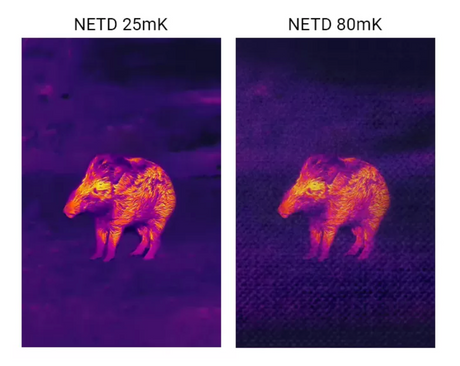
NETD (Noise Equivalent Temperature Difference) measures the smallest temperature difference the sensor can detect, expressed in millikelvins (mK). Lower is better. Sensors rated at ≤20 mK are excellent; ≤25 mK is very good; ≤30 mK is good; ≤50 mK is acceptable.
NETD matters most in low-contrast conditions — fog, rain, and cold weather where the temperature difference between your target and the background is small. A sensor with ≤20 mK NETD will maintain a clearer image in these conditions than one rated at ≤30 mK. All LRF models in our lineup rate at ≤25 mK or better — very good to excellent performance across the board.
Refresh Rate
Refresh rate is how many times per second the sensor captures a new thermal image. At 30 Hz, the image updates every 33 milliseconds — adequate for stationary targets but noticeably choppy when tracking fast-moving animals. At 50 Hz, updates drop to 20 milliseconds, producing significantly smoother tracking. The difference is immediately apparent when following a running coyote or a trotting hog.
The Athlon Cronus ATS Pro and Guide Sensmart TU 3.0 thermal scopes in our lineup all run at 50 Hz. For hunting applications, 50 Hz is the sweet spot between smooth tracking and reasonable battery consumption.
Battery Life and Power Management
Battery life varies significantly across thermal scopes — from as little as 4 hours on some models to 15+ hours on others. For a standard hunting session, plan for at least 6–8 hours of runtime.
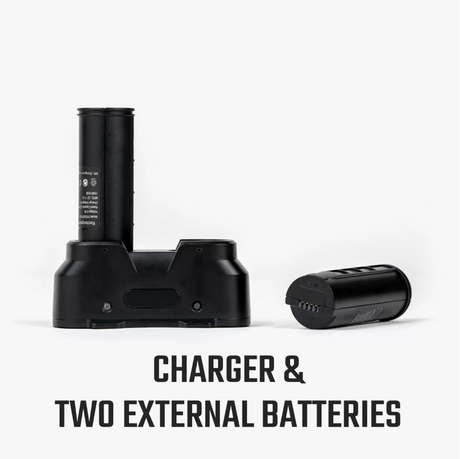
The Athlon models in our lineup are rated for 10+ hours with their three-battery system (one built-in, two external). The Alpen Apex models get about 6.5 hours per battery, with additional swappable batteries extending total runtime to approximately 15 hours. USB-C charging is standard across both brands.
Higher-resolution sensors (640-class) generally consume more power than 400-class sensors. LRF usage, WiFi streaming, and higher display brightness all reduce runtime. Carrying a charged spare battery eliminates the risk of a dead scope in the field.
LRF Range and Accuracy
The integrated rangefinder's maximum range should exceed your realistic shooting distance by a comfortable margin. The Athlon LRF models range to 1,600 yards; the Alpen models range to 1,000 meters (approximately 1,094 yards). Both exceed the practical thermal shooting range for most hunters.
Accuracy matters more than maximum range — look for ±1 yard or better. The Athlon models in our lineup meet this standard.
Reticle Options and Ballistic Features
The ability to choose between MOA and MIL reticle patterns, save multiple zeroing profiles for different loads or rifles, and use an integrated ballistic calculator are features that separate serious thermal scopes from basic models. The Athlon Cronus ATS Pro series offers 10 reticle patterns in 6 colors and 10 zeroing profiles — enough for most hunters to zero multiple rifles or ammunition types. The Alpen Apex offers multiple reticle patterns with 5 zeroing profiles.
Related Guides
- Best Night Vision Rifle Scopes 2026 — Our full roundup of digital NV and thermal picks for hunting at every budget.
- Best Night Vision Monoculars in 2026 — Handheld NV and thermal options for scouting and observation.
- Digital Night Vision Binoculars Guide — Two-eyed digital NV for immersive night viewing.
Frequently Asked Questions
Is the LRF worth the extra $300–$500?
For hunters who shoot beyond 200 yards in variable terrain, yes. The integrated rangefinder eliminates distance guesswork, reduces the time between target acquisition and shot, and feeds directly into the ballistic calculator for automatic holdover correction. For hunters who shoot under 150 yards at known distances, the non-LRF version delivers identical thermal performance at a lower price.
How far can a thermal scope detect targets?
Detection range depends on the sensor resolution, lens size, and target size. The scopes in our lineup detect a human-sized heat source at 1,800 to 2,620 meters (roughly 1,970 to 2,860 yards). However, detection is not the same as identification — you will know something is there long before you can tell what it is. Recognition range (determining whether a target is a deer vs. a coyote) is typically 40–50% of the detection range.
Do I need 640 resolution or is 400 enough?
For most hunting under 400 yards, a 400-class sensor is more than adequate. Step up to 640 resolution if you regularly need to identify targets beyond 500 yards or want the sharpest possible image quality. The Alpen Apex 640 35mm LRF now offers 640 resolution at a price point comparable to the Athlon 400-class models, making 640-resolution more accessible than ever.
Can I use a thermal scope during the day?
Yes. Thermal scopes work 24 hours a day in any lighting condition. However, thermal imaging shows heat contrast rather than visual detail — during the day, a traditional optical scope will show more surface detail (hide color, antler points, facial features) than a thermal scope. Many hunters use a clip-on thermal that can be removed for daytime use, keeping both capabilities on one rifle.
How does thermal compare to night vision for hunting?
Night vision amplifies existing light (moonlight, starlight) to create a visible image. It shows more surface detail than thermal but requires some ambient light to function — in complete darkness, you need an IR illuminator, which can be visible to other NV users. Thermal imaging detects heat and works in complete darkness without any illumination. It excels at detecting living targets against any background but shows less surface detail than NV. For predator and hog hunting where detection is the priority, thermal is the preferred technology.
What is the cheapest thermal scope available?
The Athlon Cronus ATS Pro 25-250 with Picatinny Mount starts at MSRP $999.99 with a 256x192 sensor and is the most affordable thermal scope in our lineup. It does not include an LRF, but it provides solid thermal imaging for close-range hunting under 200 yards. If you want the cheapest thermal scope with a built-in rangefinder, the Guide TU435L starts at MSRP $2,780 with a 400x300 sensor, 50 Hz refresh rate, and 1,500-meter LRF range.
Pick the Right Thermal Scope with Rangefinder for Your Hunt
The right thermal scope with rangefinder depends on how and where you hunt. Here is the short version:
- Hunting under 150 yards at known distances? Skip the LRF and save $300–$500. The non-LRF versions deliver identical thermal imaging.
- Want the most affordable LRF scope? The Guide TU435L delivers 50 Hz, IP68, and 1,500-meter rangefinding at MSRP $2,780.
- Hunting 200–500 yards and want 640-resolution? The Alpen Apex 640 35mm LRF gives you the highest-resolution 35mm LRF scope at MSRP $3,624.99.
- Want maximum features and the longest LRF range? The Athlon Cronus ATS Pro 35L-400 offers 1,600-yard ranging, 10 zeroing profiles, 128 GB storage, and a 50 Hz refresh rate.
- Need thermal and night vision in one scope? The Guide TU650M is the only dual-channel thermal + NV scope in our lineup.
- Need the sharpest image at the longest range? The Athlon Cronus ATS Pro 50L-640 is the flagship — 640-class resolution, 50mm objective, and every feature Athlon offers.
- Budget entry into thermal? The Athlon 25-250 Picatinny starts at MSRP $999.99.
All thermal scopes are available at dealer pricing — check individual product pages for current pricing.