
TL;DR — Quick Summary
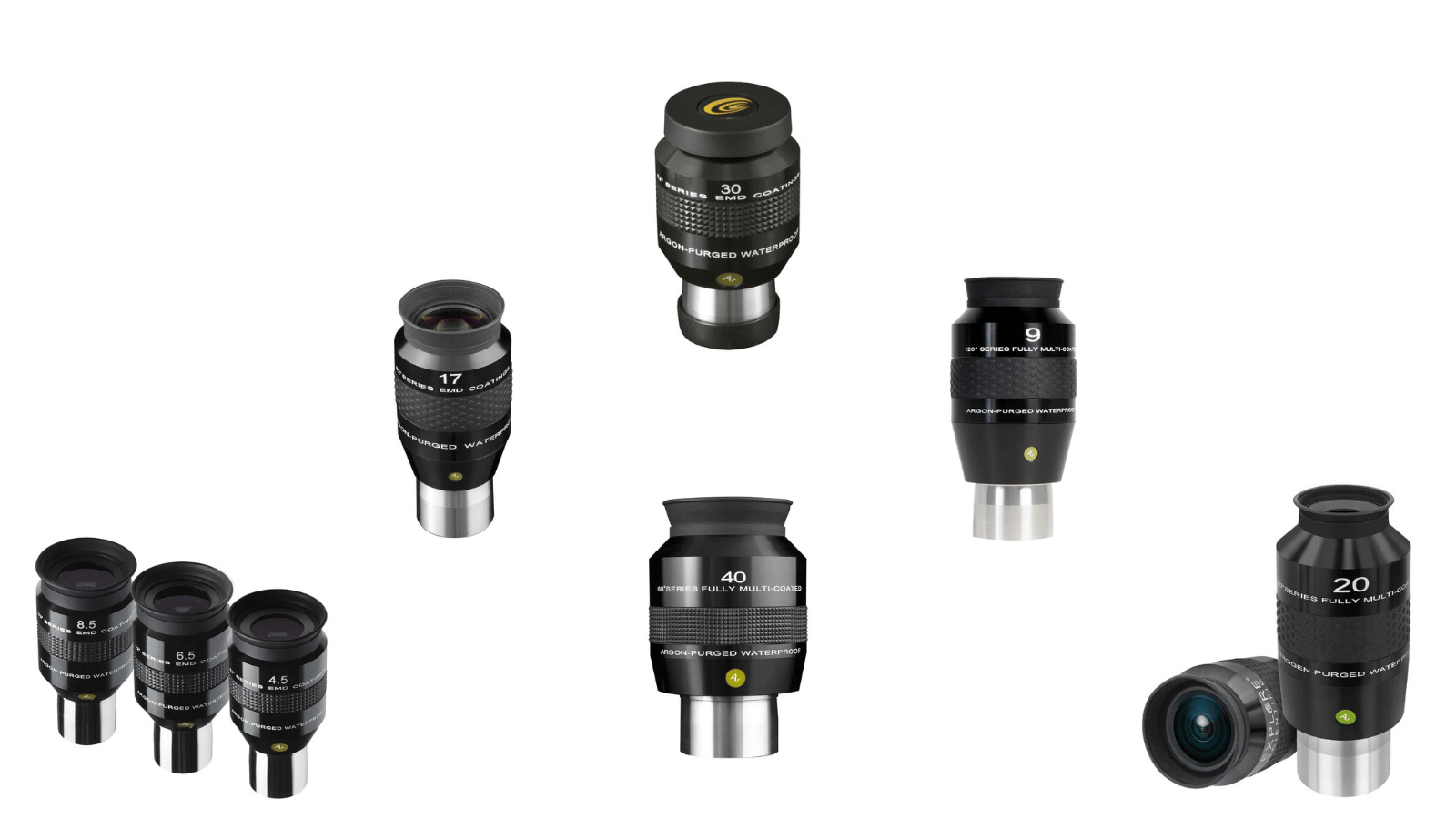
The best telescope eyepieces matter as much as the telescope itself. Start with three: a 20mm for wide-field deep-sky views, a 9mm for all-around detail, and a 5.5mm for planetary close-ups. The Explore Scientific 62° Series (MSRP $98.75 each) covers all three targets with waterproof construction, EMD coatings, and 62° apparent field of view — a strong foundation you won't outgrow quickly.
The eyepiece sitting in your telescope's focuser determines what you actually see. It controls magnification, field of view, sharpness, and viewing comfort — and choosing the best telescope eyepieces for your setup is one of the most impactful upgrades you can make. Yet most beginners spend months researching their telescope and barely think about the eyepiece that came in the box.
That kit eyepiece — usually a 25mm Kellner or basic Plössl — works, but it's a compromise. Narrow field of view, mediocre coatings, and poor eye relief mean you're seeing a fraction of what your telescope can deliver.
This guide covers how to choose the best telescope eyepieces for your setup, with specific recommendations by use case and budget. Whether you're upgrading from a kit eyepiece or building a collection from scratch, you'll find a clear path forward.
Table of Contents
What to Look for in a Telescope Eyepiece
Before recommending specific models, here are the specs that actually matter when choosing telescope eyepieces.
Magnification and Focal Length
Magnification is determined by a simple formula:
Magnification = Telescope Focal Length ÷ Eyepiece Focal Length
A 9mm eyepiece in a 1200mm focal length telescope gives you 133x. The same eyepiece in a 600mm scope gives 67x. The eyepiece doesn't have a fixed magnification — it depends on your telescope.
Maximum usable magnification is roughly 2x your telescope's aperture in millimeters. An 8-inch (203mm) Dobsonian tops out around 400x under perfect conditions, though atmospheric seeing typically limits you to 200–250x on most nights. Going beyond this just magnifies blur.
Apparent Field of View (AFOV)
AFOV is the angular width of the view you see through the eyepiece. It's the single biggest factor in how immersive the experience feels:
- 52° — Like looking through a porthole. Functional, affordable, and sharp edge-to-edge.
- 62° — Noticeably wider. Objects don't race out of view as quickly. The sweet spot for value.
- 68° — A clear step up in immersion without the weight and cost of ultra-wide designs.
- 82° — Genuinely immersive. The field edge disappears and you feel like you're floating in space.
- 100°+ — The "spacewalk" experience. Stunning, but heavy and expensive.
Your True Field of View (how much sky you see) is: TFOV = AFOV ÷ Magnification. A 20mm eyepiece with 62° AFOV on a 1200mm telescope gives about 1° of true field — enough to frame the Orion Nebula with surrounding context.
Eye Relief
Eye relief is the distance between the eyepiece lens and where your eye needs to be positioned to see the full field. Anything under 12mm forces you to press your eye uncomfortably close. If you wear glasses while observing, aim for 15mm or longer.
Explore Scientific's LER (Long Eye Relief) models are designed specifically for this — the 82° Series 8.5mm LER provides 15mm of eye relief, keeping the full field accessible to eyeglass wearers even at high magnification.
Exit Pupil
The exit pupil is the beam of light leaving the eyepiece and entering your eye:
Exit Pupil = Telescope Aperture ÷ Magnification
A fully dark-adapted young eye dilates to about 7mm. An observer over 50 might only reach 5mm. If your exit pupil exceeds your pupil size, you're wasting light. If it's too small (under 1mm), the image dims noticeably.
For deep-sky objects, aim for a 4–6mm exit pupil. For planets, 1–2mm is fine since they're bright enough.
Barrel Size: 1.25" vs 2"
Most eyepieces come in 1.25" barrels, which fit any telescope focuser. Eyepieces with longer focal lengths and wider AFOV often require 2" barrels to pass enough light for a full, unvignetted field. If your focuser accepts 2" accessories, longer focal length eyepieces in 2" format will give you a wider, brighter view.
Coatings, Weather Sealing, and Build
All Explore Scientific eyepieces use EMD (Enhanced Multi-Layer Deposition) coatings — a proprietary multi-coating process that maximizes light transmission and reduces internal reflections. The result is brighter images with better contrast, especially noticeable on faint deep-sky targets.
Every model in the lineup is also argon-purged and waterproof. This prevents internal fogging when you bring a cold eyepiece indoors or when dew settles during a long observing session. It's a feature normally found only on premium binoculars, and it means these eyepieces will last decades without developing internal haze.
Our Picks: Best Telescope Eyepieces by Use Case
Best Starter Set Under $300

If you're buying your first quality eyepieces, the 62° Series is the strongest value in the lineup. Every focal length from 5.5mm to 40mm is currently available, pricing starts at MSRP $98.75, and the 62° AFOV is wide enough to feel immersive without the bulk or cost of ultra-wide designs.
Recommended three-eyepiece starter kit:
| Eyepiece | Use | Magnification (8" f/6 Dob) | MSRP |
|---|---|---|---|
| 62° Series 20mm | Wide-field / deep-sky | 60x | $98.75 |
| 62° Series 9mm | All-around / detail | 133x | $98.75 |
| 62° Series 5.5mm | Planetary / lunar | 218x | $98.75 |
This set covers the full magnification range for an 8" f/6 Dobsonian — the most popular beginner scope — and each eyepiece works equally well in refractors and SCTs. At MSRP $296.25 for all three, it costs less than a single premium wide-field eyepiece from most competitors, and you get far more versatility. These are waterproof, EMD-coated, multi-element eyepieces at a price point that was previously entry-level territory.
Best for Planets and the Moon

Planetary observing demands high magnification with sharp contrast. You need a short focal length eyepiece that still delivers comfortable eye relief.
Top pick: Explore Scientific 82° Series 8.5mm LER (MSRP $173.75) — High magnification with 15mm eye relief and a wide 82° field. On an 8" f/6 scope, this gives 141x with room to spare before hitting seeing limits. The wide field keeps planets in view longer as the Earth rotates, reducing the constant nudging that plagues narrow-field planetary eyepieces.
Budget pick: Explore Scientific 52° Series 6.5mm (MSRP $73.75) — At a fraction of the price, the 52° Series still delivers sharp, high-contrast views with 15.9mm eye relief. The narrower field is the trade-off, but for dedicated planetary work where you're centered on one bright target, 52° is plenty.
Best for Deep-Sky Objects

Nebulae, galaxies, and star clusters benefit from lower magnification and the widest possible field of view. You want a longer focal length eyepiece that delivers a large exit pupil for maximum brightness on faint targets.
Top pick: Explore Scientific 82° Series 30mm (MSRP $348.75) — A 2" eyepiece with 22mm of eye relief and a massive 82° apparent field. On an 8" f/6 scope, this gives 40x with a 5mm exit pupil — ideal for the Orion Nebula, Andromeda Galaxy, and large open clusters like the Pleiades. The wide field frames these objects with their surrounding starfields intact.
Value pick: Explore Scientific 62° Series 26mm (MSRP $123.75) — A 1.25" eyepiece that delivers excellent deep-sky performance at a more accessible price. At 46x on the same scope, it provides a 4.4mm exit pupil in a lighter, more compact package.
Best Wide-Field Immersive Experience

For observers who want the most dramatic views possible — starfields that stretch to the edges of your vision, clusters that fill the frame — ultra-wide AFOV eyepieces deliver an experience that narrower designs simply cannot match.
Flagship pick: Explore Scientific 120° Series 9mm (MSRP $1,123.75) — The widest apparent field of view available in any eyepiece, period. Looking through a 120° eyepiece is like floating in space — the field edges vanish entirely, and you're surrounded by stars. At 9mm focal length, it delivers 133x on an 8" f/6 scope, making it equally stunning on rich Milky Way starfields and detailed planetary views.
Premium pick: Explore Scientific 100° Series 30mm (MSRP $1,248.75) — A 3" format eyepiece that pairs ultra-wide 100° AFOV with a long 30mm focal length for maximum sky coverage. This is the eyepiece for sweeping the Milky Way in a fast Newtonian or Dobsonian.
Best for Eyeglass Wearers
If you observe with glasses on, eye relief is your priority. Look for 15mm or longer to see the full field without pressing your eye against the lens.
Recommended picks with verified 15mm+ eye relief:
- 52° Series 15mm — 16.3mm eye relief (MSRP $73.75)
- 52° Series 6.5mm — 15.9mm eye relief (MSRP $73.75)
- 82° Series 8.5mm LER — 15mm eye relief (MSRP $173.75)
- 82° Series 24mm — 17.5mm eye relief (MSRP $286.25)
- 82° Series 30mm — 22mm eye relief (MSRP $348.75)
Eyepiece Series at a Glance
This table compares every Explore Scientific eyepiece series to help you decide which tier fits your needs and budget.
| Series | AFOV | Barrel Sizes | Price Range (MSRP) | Best For |
|---|---|---|---|---|
| 52° Series | 52° | 1.25", 2" | $73.75 – $123.75 | Budget-conscious observers, dedicated planetary work |
| 62° Series | 62° | 1.25", 2" | $98.75 – $198.75 | Best overall value, versatile starter set |
| 68° Series | 68° | 1.25", 2" | $136.25 – $361.25 | Lanthanum glass upgrade with wider field |
| 82° Series | 82° | 1.25", 2" | $173.75 – $348.75 | Immersive deep-sky and wide-field observing |
| 92° Series | 92° | 2" | $373.75 | Maximum eye relief with ultra-wide field |
| 100° Series | 100° | 2", 3" | $373.75 – $1,248.75 | Flagship wide-field deep-sky experience |
| 120° Series | 120° | 2" | $1,123.75 | The ultimate spacewalk field of view |
Expanding Your Kit with Focal Extenders
A focal extender multiplies your telescope's focal length, effectively increasing magnification for every eyepiece you own. Unlike cheap Barlow lenses that can degrade image quality, Explore Scientific's focal extenders are fully multi-coated, 4-element optical designs that maintain sharpness and contrast across the field.
How they work: A 2x focal extender doubles magnification. Your 20mm eyepiece becomes a 10mm equivalent. A 3x triples it. A 5x turns a 20mm into a 4mm equivalent — extreme planetary magnification from a comfortable, long-eye-relief eyepiece.
Available focal extenders:
| Model | Multiplier | Barrel | MSRP |
|---|---|---|---|
| 1.25" 2x Focal Extender | 2x | 1.25" | $124.99 |
| 1.25" 3x Focal Extender | 3x | 1.25" | $149.99 |
| 1.25" 5x Focal Extender | 5x | 1.25" | $137.49 |
| 2" 2x Focal Extender | 2x | 2" | $187.49 |
| 2" 3x Focal Extender | 3x | 2" | $187.49 |
When to use a focal extender vs. buying another eyepiece: If you already own a quality 20mm and need more magnification, a 2x extender gives you an effective 10mm for less money than buying a separate 10mm eyepiece. The trade-off is that stacking optics can introduce very slight contrast loss, though with quality extenders the difference is negligible. A focal extender is most valuable when you want to fill gaps in your collection without buying a full eyepiece for every focal length.
How to Build Your Eyepiece Collection
Don't buy everything at once. Build strategically.
Start with Three
One low-power eyepiece (20–30mm) for deep-sky objects. One mid-range (9–14mm) for general observing. One high-power (5–8mm) for planets and the Moon. This covers 90% of what you'll observe in your first year.
Add a Focal Extender
Once you have your core three, a 2x focal extender doubles your effective collection to six magnifications. This is almost always better value than buying a fourth eyepiece.
Match to Your Telescope
Your telescope's focal length and aperture determine which eyepiece focal lengths are useful.
| Telescope Type | Typical Focal Length | Low Power (30–50x) | Mid Power (80–150x) | High Power (180–250x) |
|---|---|---|---|---|
| 8" f/6 Dobsonian | 1200mm | 24–40mm | 8–15mm | 5–6.5mm |
| 80mm f/6 Refractor | 480mm | 10–16mm | 3–6mm + extender | Aperture-limited (~160x max) |
| 5" f/10 SCT | 1250mm | 25–40mm | 8–16mm | 5–7mm |
| 6" f/8 Newtonian | 1200mm | 24–40mm | 8–15mm | 5–6.5mm |
For shorter focal length scopes (like an 80mm f/6 refractor with 480mm focal length), you'll reach useful magnification limits quickly. A 5.5mm eyepiece gives 87x — reasonable, but to reach higher magnifications for planetary detail, a 2x or 3x focal extender paired with a longer eyepiece is more practical than buying an ultra-short focal length eyepiece with tight eye relief.
When to Upgrade
Upgrade when your eyepiece is the bottleneck. If you're seeing sharp details at the center of the field but the edges are mushy, a wider-AFOV eyepiece will help. If you're struggling with eye relief, the LER variants or 82° series will solve it. If your views are dim and narrow at low power, a 2" wide-field eyepiece opens things up dramatically.
Don't upgrade if your limiting factor is atmospheric seeing (turbulence that makes stars shimmer) or light pollution. No eyepiece fixes those problems.
Frequently Asked Questions
What eyepiece focal length should I start with?
A mid-range focal length between 9mm and 15mm is the most versatile starting point. It provides enough magnification for planetary detail while still delivering a reasonable field of view for deep-sky objects. From there, add a low-power eyepiece (20–30mm) for wide-field, then a high-power (5–8mm) for planets.
How many eyepieces do I need?
Three quality eyepieces (low, mid, high magnification) plus a 2x focal extender covers virtually everything you'll want to observe. Many experienced observers settle on 4–6 eyepieces total. Resist the urge to buy a full set of a dozen focal lengths — you'll use three or four of them 95% of the time.
Are expensive eyepieces worth the upgrade?
It depends on what you're upgrading from. Going from a kit Plössl to a 62° Series eyepiece is a dramatic improvement — wider field, better coatings, weather sealing, and superior eye relief. At MSRP $98.75, the 62° series costs less than many basic Plössls from other brands. The jump from 62° to 82° adds about $75 per eyepiece and is genuinely noticeable — the immersive 82° field is worth it for serious observers. The jump from 82° to 100° is more subtle and mostly benefits experienced observers who already have excellent telescopes and dark skies.
Can I use any eyepiece with my telescope?
Any 1.25" eyepiece fits any telescope with a 1.25" focuser (which is virtually all of them). To use 2" eyepieces, your focuser needs a 2" opening — most Dobsonians and mid-range refractors include this, but some entry-level scopes only accept 1.25". Check your focuser before buying a 2" eyepiece.
What's the difference between a Barlow lens and a focal extender?
Both multiply magnification, but a focal extender uses a fully multi-coated, 4-element optical design that maintains image quality across the entire field of view. Budget Barlow lenses can introduce chromatic aberration, soften edges, and reduce contrast. For Explore Scientific eyepieces — which are engineered for edge-to-edge sharpness — a matching focal extender preserves that performance, while a cheap Barlow can undo it.
Why are all Explore Scientific eyepieces waterproof?
Dew is the enemy of nighttime observing. When a cold eyepiece is exposed to humid air — or brought indoors after a session — moisture can condense on and inside the optical elements. Argon purging replaces internal air with dry argon gas, preventing internal fogging permanently. The waterproof seal also keeps dust and moisture out during storage and transport. This is the same technology used in premium binoculars and spotting scopes, applied across the entire eyepiece lineup.